
Reviewed by clinicaobesidadenvejecimiento.com · Last review:

Both techniques remove localized fat with cannulas; the difference is that in laser lipolysis a fiber liquefies the fat before removal. According to a 2025 review, laser assistance causes less bruising and pain, a recovery about 3 days faster and better skin appearance. Traditional liposuction keeps advantages for large volumes and has a well-known long-term safety profile. The laser-specific risk is a burn if energy is not controlled. The choice depends on each patient’s areas, volume and skin.
- Head-to-head comparison
- Recovery
- Safety
How they are alike
Both are surgical procedures to contour localized fat, not to lose weight. Both use small incisions, infiltration of the area and cannulas to remove fat. Neither replaces a health plan when there is overweight or obesity, conditions that according to Ensanut 2022 affect most adults in Mexico.
How they differ
In laser lipolysis, before suction, a fiber emitting laser energy is inserted that liquefies the fat and heats the deep layer of the skin, promoting some retraction. In traditional liposuction, fat is broken up and suctioned mechanically.
Comparison according to the evidence
| Aspect | Laser lipolysis | Traditional liposuction |
|---|---|---|
| Bruising | Less and shorter-lasting | 39% with bruising over a week |
| Post-operative pain | About 40% less | Higher |
| Return to activities | About 3 days earlier | Later |
| Skin retraction | Better appearance in studies | Less effect |
| Large volumes | Less indicated | Advantage and long-term safety profile |
| Specific risk | Burns if energy is not controlled | Irregularities, seroma |
Source: Manzano-Finol et al., Aesthetic Plastic Surgery 2025.
When each one fits
Laser lipolysis is often preferred for
- Small or medium areas
- Skin with mild laxity
- A need for faster recovery
- Delicate areas such as arms or double chin
Traditional is often preferred for
- Large volumes of fat
- Several extensive areas at once
- Cases where heat adds no benefit
Safety: what to know
- In a series of 1,000 laser lipolysis cases cited in the 2025 review there were 3 burns, 2 infections, 1 hematoma and 1 seroma, with no major complications.
- A 2026 review warns that assisted technologies (laser, ultrasound, radiofrequency) require experience and caution to avoid complications.
- The ASPS recommends hospital care and overnight monitoring when more than 5 liters are removed, with any technique.
The most suitable technique is the one the surgeon indicates after assessing areas, volume and skin quality; there is no single best option for everyone.
Recovery side by side
Both use compression garments as indicated and walking is encouraged from the first days. With laser lipolysis, studies report less bruising and a faster return; for the arms, a 2025 meta-analysis described only temporary bruising and swelling. The final contour takes shape over weeks to months as swelling subsides.
Myth and fact
Myth: “Laser lipolysis is not surgery.”
Fact: It is a minimally invasive surgical procedure with anesthesia and incisions.
Myth: “Traditional liposuction is obsolete.”
Fact: It keeps advantages for large volumes and a known safety profile (2025).
Myth: “Any amount can be removed with laser.”
Fact: Large volumes require ASPS safety criteria.
Myth: “Both are for weight loss.”
Fact: They contour localized fat; they do not treat obesity.
Not sure which technique suits you?
In an assessment we review your areas, volume and skin to recommend the right option.
Book an assessmentFrequently asked questions
Which hurts less?
Studies report about 40% less pain with laser assistance.
Which has the faster recovery?
Laser lipolysis, about 3 days earlier in comparative studies.
Which is safer?
Both are safe in expert hands; each has its own risks (2026 review).
Which is better for a lot of fat?
Traditional liposuction or megalipolysis planned with safety criteria.
Does the laser tighten skin?
It promotes some retraction but does not replace skin surgery.
Can they be combined?
Yes; many authors describe laser as a complement to liposuction.
Keep reading
Downloadable quick guide. The key differences between laser lipolysis and liposuction, in one image.
Download infographic (PNG)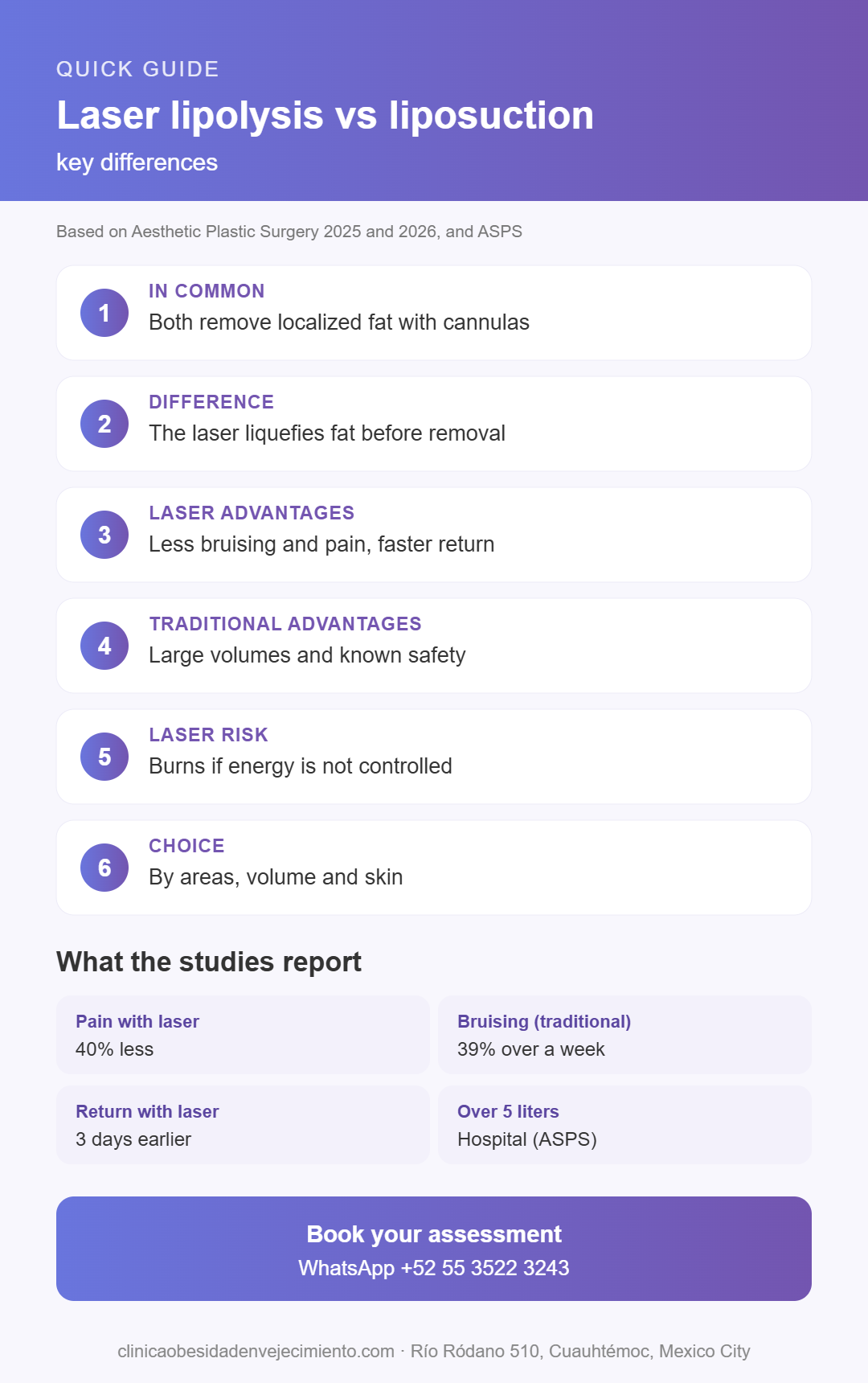
Sources
- Manzano-Finol A, et al. Laser-assisted lipolysis: a promising alternative to traditional liposuction. Aesthetic Plast Surg. 2025. PubMed
- Uncovering the complications of liposuction-assisted technologies and the need for caution: a literature review. Aesthetic Plast Surg. 2026. PubMed
- Impact of laser lipolysis with and without liposuction on arm circumference: a systematic review and meta-analysis. Aesthet Surg J Open Forum. 2025. PubMed
- American Society of Plastic Surgeons. Executive summary on liposuction. ASPS
- Campos-Nonato I, et al. Prevalence of obesity in Mexican adults: Ensanut 2022. Salud Publica Mex. 2023;65(suppl 1):S238-S247. INSP