
Reviewed by clinicaobesidadenvejecimiento.com · Last review:

Laser lipolysis is used to contour areas of localized fat that do not respond to diet and exercise, such as the abdomen, waist, arms and double chin. A laser fiber liquefies fat under the skin, which is then removed with fine cannulas. According to a 2025 review in Aesthetic Plastic Surgery, compared with traditional liposuction it causes less bruising and pain and allows a return to activities about 3 days earlier. It is not a weight-loss treatment: it works best in people with a stable weight and realistic expectations.
- Areas it treats
- Ideal candidate
- Results and risks
What it is for
Laser lipolysis, also called laser-assisted liposuction, is used to contour the body in areas where fat builds up and resists diet and exercise. It is not a weight-loss method: it removes localized fat to improve shape.
In Mexico, according to Ensanut 2022, 38.3% of adults are overweight, 36.9% have obesity and 81% have abdominal obesity. That is why it is important to tell localized fat, which can be contoured, from excess weight, which needs a comprehensive health plan.
How it works
- Assessment: areas, skin quality, general health and expectations.
- Anesthesia and small incisions: the area is infiltrated.
- Laser: a fiber under the skin liquefies fat with thermal energy and stimulates some skin retraction.
- Removal: the liquefied fat is removed with fine cannulas.
Most commonly treated areas
Body
- Abdomen and waist
- Flanks (“love handles”)
- Arms
- Back and thighs, depending on the case
Face and neck
- Double chin
- Jawline, depending on assessment
For the arms, a 2025 meta-analysis found reduced circumference with mild, temporary complications (Aesthet Surg J Open Forum).
What the studies say
| Outcome | Laser lipolysis | Traditional liposuction |
|---|---|---|
| Post-operative pain | About 40% less | Higher |
| Bruising lasting over a week | Minimal | 39% of patients |
| Return to activities | About 3 days earlier | Later |
| Skin appearance | Better in studies | Less effect |
Source: 2025 review in Aesthetic Plastic Surgery, co-authored by Dr. Gabriel Cubillos, the clinic’s scientific director.
Who is a good candidate
Usually a candidate
- Stable weight, at or near ideal
- Stubborn localized fat
- Skin with acceptable elasticity
- Good general health
Not the right fit
- People seeking weight loss
- Significant skin laxity
- Uncontrolled illnesses
Real risks
In a series of 1,000 consecutive cases cited in the 2025 review there were 3 burns, 2 infections, 1 hematoma and 1 seroma, with no major complications; 7.3% needed a touch-up. The laser-specific risk is thermal burns if energy is not controlled. A 2026 review stresses that assisted technologies require experience to avoid complications.
The ASPS recommends hospital care and monitoring when more than 5 liters are removed; large volumes correspond to megalipolysis and are planned with those criteria.
How to keep the result
Removed fat cells do not come back, but the remaining ones can grow with weight gain. Keeping the result depends on diet, physical activity and medical follow-up.
Myth and fact
Myth: “It is for weight loss.”
Fact: It contours localized fat; weight control needs a comprehensive health plan.
Myth: “Laser has no risks.”
Fact: It can cause burns if energy is not controlled (2025 review).
Myth: “The result is immediate.”
Fact: The contour takes shape as swelling subsides.
Myth: “The fat always comes back.”
Fact: Removed cells do not return, but remaining ones can grow with weight gain.
Do you have stubborn localized fat?
In an assessment we review your areas and skin to see whether laser lipolysis is right for you.
Book an assessmentFrequently asked questions
How long does the procedure take?
About 2 to 3 hours, depending on the areas.
Does it hurt?
It is done under anesthesia; studies report less pain than traditional liposuction.
When can I return to my activities?
In studies, about 3 days earlier than with traditional liposuction (2025).
Does it tighten the skin?
It promotes some retraction but does not replace skin surgery for significant laxity.
Do I need a compression garment?
Compression is indicated depending on the case.
Is it the same as megalipolysis?
Megalipolysis applies the same technology to several areas or a larger volume.
Keep reading
Downloadable quick guide. What it is for, areas, ideal candidate and risks, in one image.
Download infographic (PNG)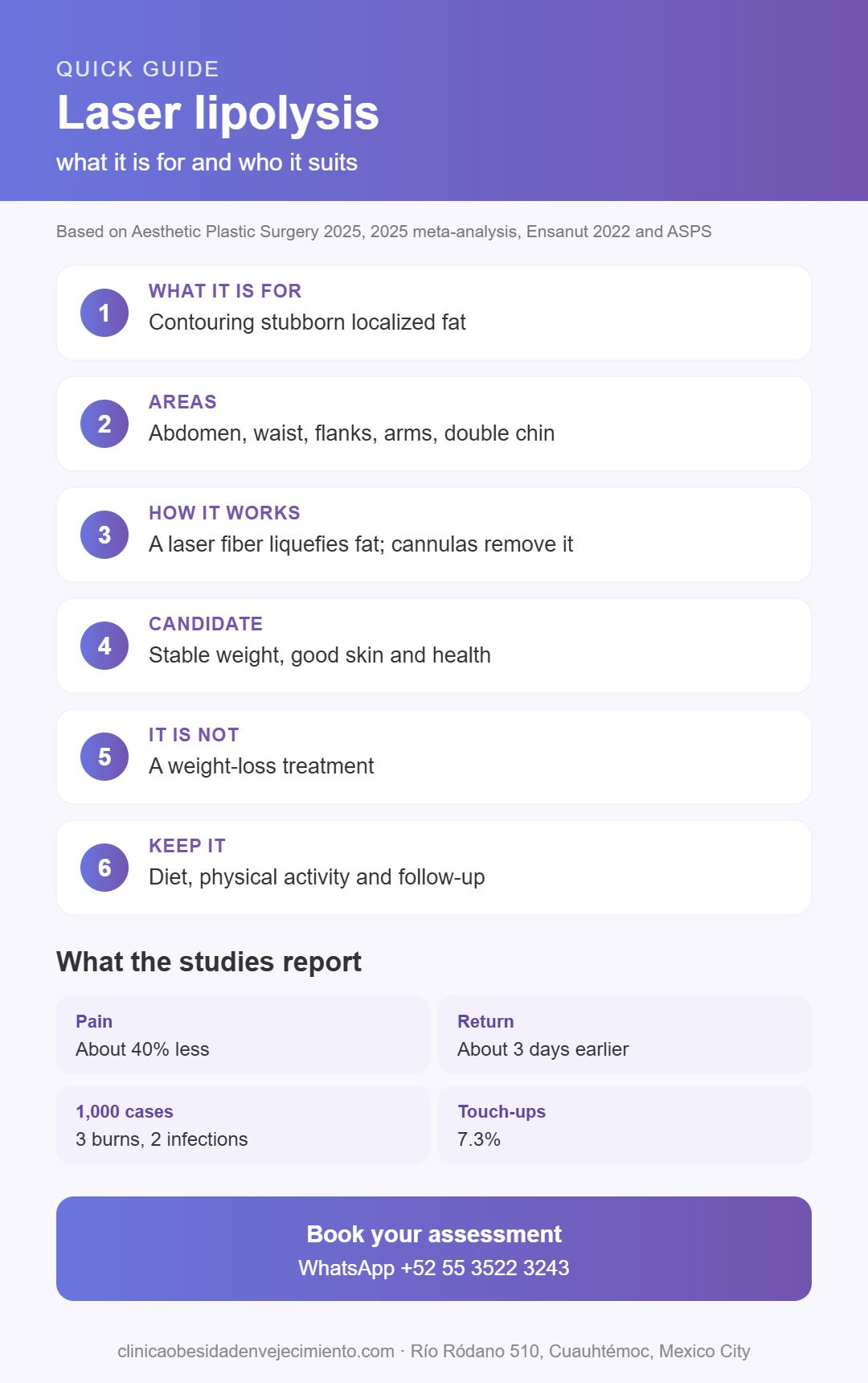
Sources
- Manzano-Finol A, et al. Laser-assisted lipolysis: a promising alternative to traditional liposuction. Aesthetic Plast Surg. 2025. PubMed
- Impact of laser lipolysis with and without liposuction on arm circumference: a systematic review and meta-analysis. Aesthet Surg J Open Forum. 2025. PubMed
- Uncovering the complications of liposuction-assisted technologies and the need for caution: a literature review. Aesthetic Plast Surg. 2026. PubMed
- Campos-Nonato I, et al. Prevalence of obesity in Mexican adults: Ensanut 2022. Salud Publica Mex. 2023;65(suppl 1):S238-S247. INSP
- American Society of Plastic Surgeons. Executive summary on liposuction. ASPS