Reviewed by clinicaobesidadenvejecimiento.com · Last review:

Laser megalipolysis is laser-assisted lipolysis that treats several areas of the body or a larger volume of fat in a single procedure. It suits people with localized fat in several areas, good general health and a commitment to healthy habits afterwards; it is not weight-loss surgery. Because larger volumes are involved, safety is central: the American Society of Plastic Surgeons recommends a hospital setting and overnight monitoring when more than 5 liters are removed. Choosing a clinic with certified surgeons and a full assessment is part of the result.
- Ideal candidate
- Prior tests
- Safe clinic
- Who it is for
- Fat in several areas, with good general health (Aesthetic Plast Surg 2025)
- Duration
- About 2 to 3 hours, depending on the areas
- Anesthesia
- Depends on volume; over 5 liters requires a hospital (ASPS)
- Recovery
- Compression and check-ups; contour defined over months (2025 review)
- Results
- 1.1% complications below 5 liters (ASPS 2015)
What it is and how it differs from lipolysis
It uses the same technology as laser lipolysis: a fiber that liquefies fat before removal with fine cannulas. The difference is scope: several areas or a larger volume in a single procedure. According to the 2025 review in Aesthetic Plastic Surgery, laser assistance is associated with less bruising and faster recovery than the traditional technique.
Who it is for
It is for people with localized fat in several areas, good general health and a commitment to their habits.
Usually a candidate
- Localized fat in several areas that resists diet and exercise
- Lab tests and general health in order
- Commitment to diet and physical activity afterwards
- Realistic expectations about contour
Not the right fit
- People seeking weight loss through surgery
- Uncontrolled chronic illnesses
- Significant laxity needing skin surgery
- Expecting an immediate result
In Mexico, Ensanut 2022 reports 36.9% of adults with obesity and 81% with abdominal obesity. When there is obesity, body contouring complements a metabolic plan; it is not the main treatment.
Tests needed beforehand
Before the procedure, a full medical assessment, lab tests and a surgical risk evaluation are required.
- Full medical history and examination.
- Lab tests according to age and health.
- Surgical and anesthetic risk assessment.
- Measuring areas and planning the volume to remove.
Volume and safety
Safety depends on volume: above 5 liters, the ASPS recommends a hospital and overnight monitoring.
| Criterion | What the evidence recommends | Source |
|---|---|---|
| Over 5 liters | Hospital setting and overnight monitoring | ASPS |
| Complications by volume | 3.7% above 5 liters vs 1.1% below; difference mostly due to seromas | ASPS 2015 |
| Laser energy | Parameter control to avoid burns | 2025 review |
| Experience | Assisted technologies require caution and training | 2026 review |
How to choose a safe clinic
A safe clinic has certified surgeons, a full assessment, a volume plan and follow-up.
- Certified surgeon: COFEPRIS recommends checking registration with the Mexican Council of Plastic, Aesthetic and Reconstructive Surgery.
- Full assessment with tests before scheduling.
- A clear volume plan and hospital criteria when applicable.
- Facilities with health certification and an anesthesia team.
- Post-operative follow-up included in the plan.
- Clear information on risks, with no guaranteed results.
Red flags when choosing
Promises of guaranteed sizes or kilos and surgery without assessment or tests are warning signs.
- Promising many sizes or kilos lost with one surgery.
- Scheduling without tests or an in-person assessment.
- Not explaining the volume to remove or the follow-up plan.
The clinic has the scientific backing of Dr. Gabriel Cubillos, co-author of the 2025 review on laser-assisted lipolysis.
Myth and fact
Myth: “It is weight-loss surgery.”
Fact: It contours several areas; weight is managed with a comprehensive plan (ASPS).
Myth: “The more fat removed, the better.”
Fact: The ASPS sets volume limits and monitoring for safety.
Myth: “Any place can do it.”
Fact: It requires certified surgeons and proper facilities (COFEPRIS).
Myth: “Tests are unnecessary.”
Fact: Assessment and lab tests are part of safety (ASPS).
Want to know if you are a candidate?
Book a comprehensive assessment: we review areas, health and a safe volume for your case.
Book an assessmentFrequently asked questions
How many areas are treated?
It depends on each patient and the safe volume; it is defined in the assessment.
Do I need to stay in hospital?
Above 5 liters, the ASPS recommends a hospital with overnight monitoring.
Which tests will I need?
Lab tests and a surgical risk assessment, depending on the case.
How long does it take?
About 2 to 3 hours, depending on the areas.
Can I have it if I have obesity?
It is assessed within a comprehensive plan; it does not replace weight treatment.
How do I verify the surgeon?
In the registry of the Mexican Council of Plastic, Aesthetic and Reconstructive Surgery.
Keep reading
Downloadable quick guide. Who it is for, prior tests and how to choose a safe clinic, in one image.
Download infographic (PNG)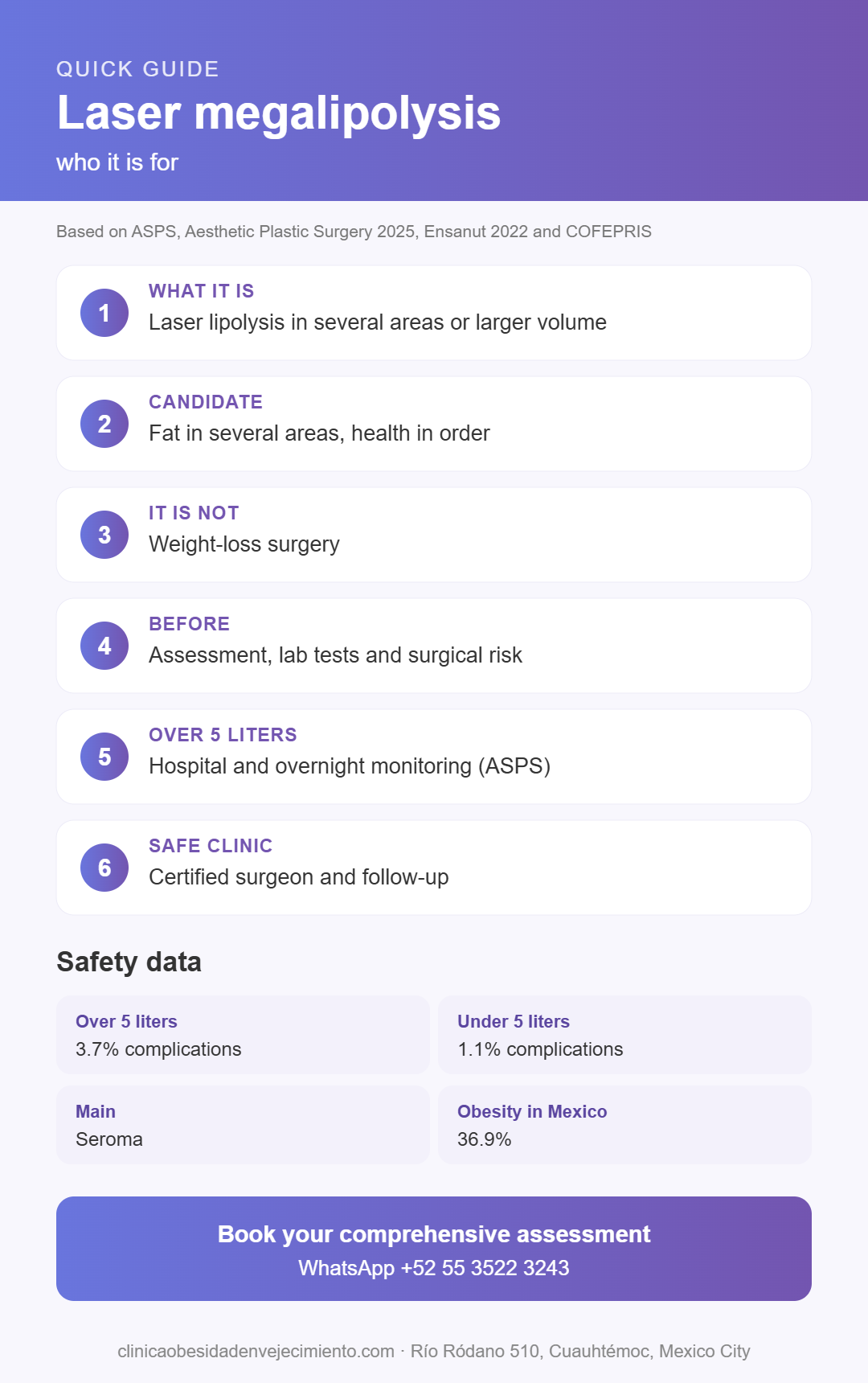
Sources
- Manzano-Finol A, et al. Laser-assisted lipolysis: a promising alternative to traditional liposuction. Aesthetic Plast Surg. 2025. PubMed
- American Society of Plastic Surgeons. Executive summary on liposuction. ASPS
- American Society of Plastic Surgeons. How much liposuction is safe? The answer varies by body weight. 2015. ASPS
- Uncovering the complications of liposuction-assisted technologies and the need for caution: a literature review. Aesthetic Plast Surg. 2026. PubMed
- Campos-Nonato I, et al. Prevalence of obesity in Mexican adults: Ensanut 2022. Salud Publica Mex. 2023;65(suppl 1):S238-S247. INSP
- COFEPRIS. Statement 96/2023: recommendations on cosmetic procedures. gob.mx