
Reviewed by clinicaobesidadenvejecimiento.com · Last review:

A laser megalipolysis treatment is more than surgery day. It includes a full medical assessment with tests, planning of areas and safe volume, the procedure with anesthesia and laser technology, compression garments, post-operative check-ups and follow-up to protect the result. Knowing each stage helps compare options wisely: a serious plan explains the volume to remove, the ASPS safety criteria and who handles follow-up, and does not promise guaranteed results.
- Stage by stage
- What it should include
- Questions to compare
1. Medical assessment
- Medical history, medications and background.
- Examination and measurement of the areas to treat.
- Skin quality evaluation.
- A conversation about expectations and habits.
This is the time to confirm that the goal is contouring and not weight loss, since megalipolysis does not replace treatment of overweight, which according to Ensanut 2022 affects 38.3% of adults in Mexico.
2. Tests and planning
- Lab tests according to each patient.
- Surgical and anesthetic risk assessment.
- A plan of areas and volume, with safety criteria: the ASPS recommends a hospital and overnight monitoring above 5 liters.
3. Procedure day
- Marking of the areas.
- Anesthesia and infiltration.
- Laser-assisted lipolysis: the fiber liquefies fat and stimulates some skin retraction.
- Removal with fine cannulas.
- Placing the compression garment.
It takes about 2 to 3 hours, depending on the areas.
4. Afterwards: compression and check-ups
| What it includes | What it is for |
|---|---|
| Compression garment | Helps control swelling and lets the skin adapt |
| Post-operative check-ups | Check incisions and catch seromas or other complications early |
| Written instructions | Care, medication and warning signs |
| Final assessment | Review the contour once swelling subsides and consider a touch-up |
5. Follow-up to keep the result
The plan should include guidance on diet and physical activity. Removed fat cells do not return, but remaining ones can grow with weight gain.
Questions to compare options
A serious plan answers
- Who is the surgeon and are they certified?
- What volume will be removed and why?
- Where is it performed and with what anesthesia team?
- Which check-ups are included and who does them?
Red flags
- Guaranteed sizes or kilos
- Scheduling without tests or assessment
- No explanation of risks or follow-up
COFEPRIS recommends checking that the surgeon is registered with the Mexican Council of Plastic, Aesthetic and Reconstructive Surgery. A 2026 review stresses that assisted technologies require experience to avoid complications.
Myth and fact
Myth: “The treatment is just surgery day.”
Fact: It includes assessment, tests, check-ups and follow-up.
Myth: “The garment is optional.”
Fact: Compression is part of the care prescribed by the doctor.
Myth: “All plans are the same.”
Fact: They differ by volume, areas, safety criteria and follow-up.
Myth: “A good plan guarantees sizes.”
Fact: No serious plan promises guaranteed results.
Want to see your plan step by step?
In an assessment we explain each stage, the tests and the right follow-up for you.
Book an assessmentFrequently asked questions
Which tests are included?
Lab tests and a surgical risk assessment according to each patient.
Is the compression garment included?
Compression is part of the plan; the doctor sets the type and duration.
How many check-ups are there?
They are scheduled according to progress and include a final contour assessment.
How long does the procedure take?
About 2 to 3 hours.
Is a hospital stay needed?
Above 5 liters, the ASPS recommends it with overnight monitoring.
What if I need a touch-up?
It is assessed at the end, once swelling has subsided.
Keep reading
Downloadable quick guide. The treatment stages and questions to compare options, in one image.
Download infographic (PNG)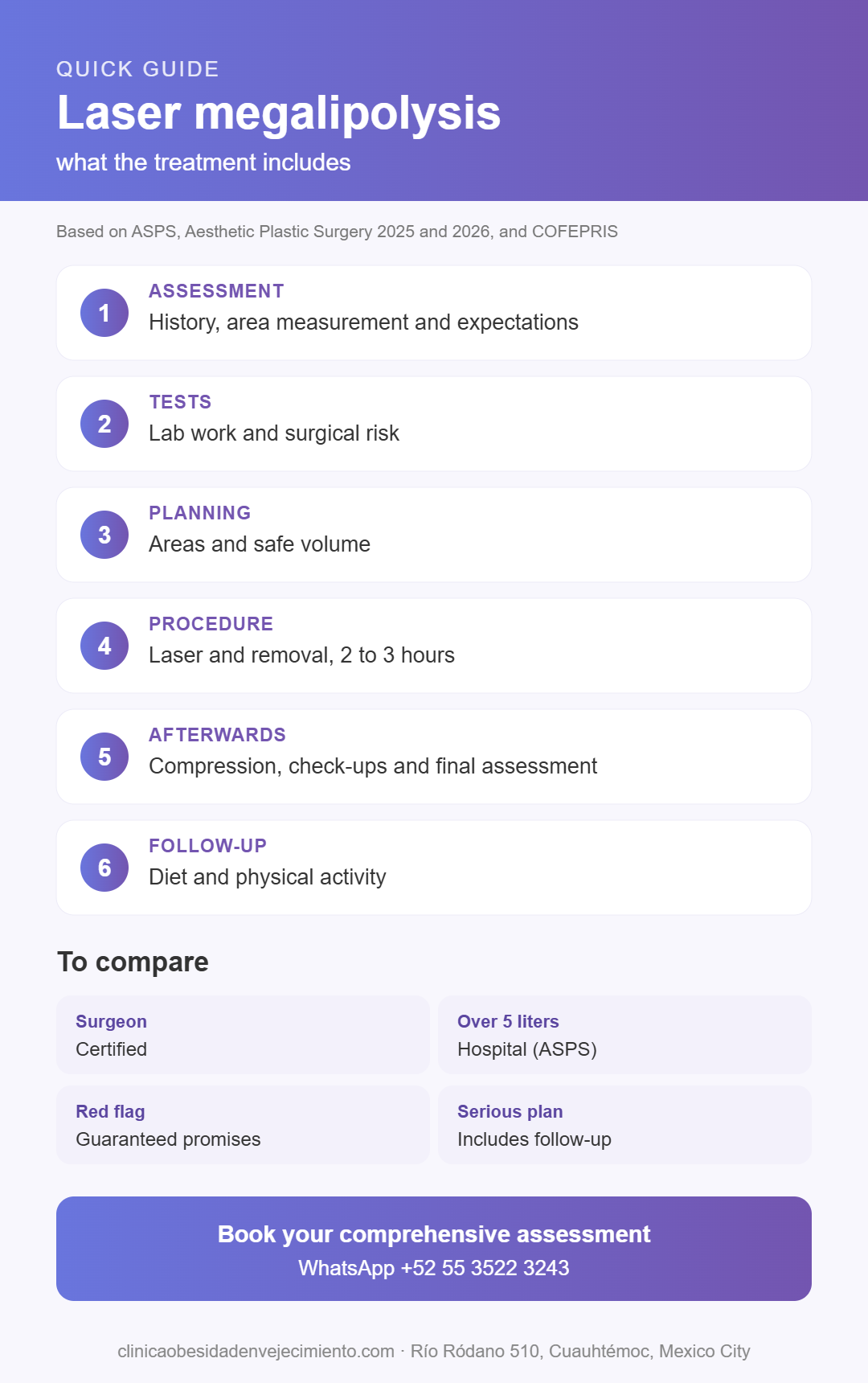
Sources
- American Society of Plastic Surgeons. Executive summary on liposuction. ASPS
- Manzano-Finol A, et al. Laser-assisted lipolysis: a promising alternative to traditional liposuction. Aesthetic Plast Surg. 2025. PubMed
- Uncovering the complications of liposuction-assisted technologies and the need for caution: a literature review. Aesthetic Plast Surg. 2026. PubMed
- Campos-Nonato I, et al. Prevalence of obesity in Mexican adults: Ensanut 2022. Salud Publica Mex. 2023;65(suppl 1):S238-S247. INSP
- COFEPRIS. Statement 96/2023: recommendations on cosmetic procedures. gob.mx