
Reviewed by clinicaobesidadenvejecimiento.com · Last review:
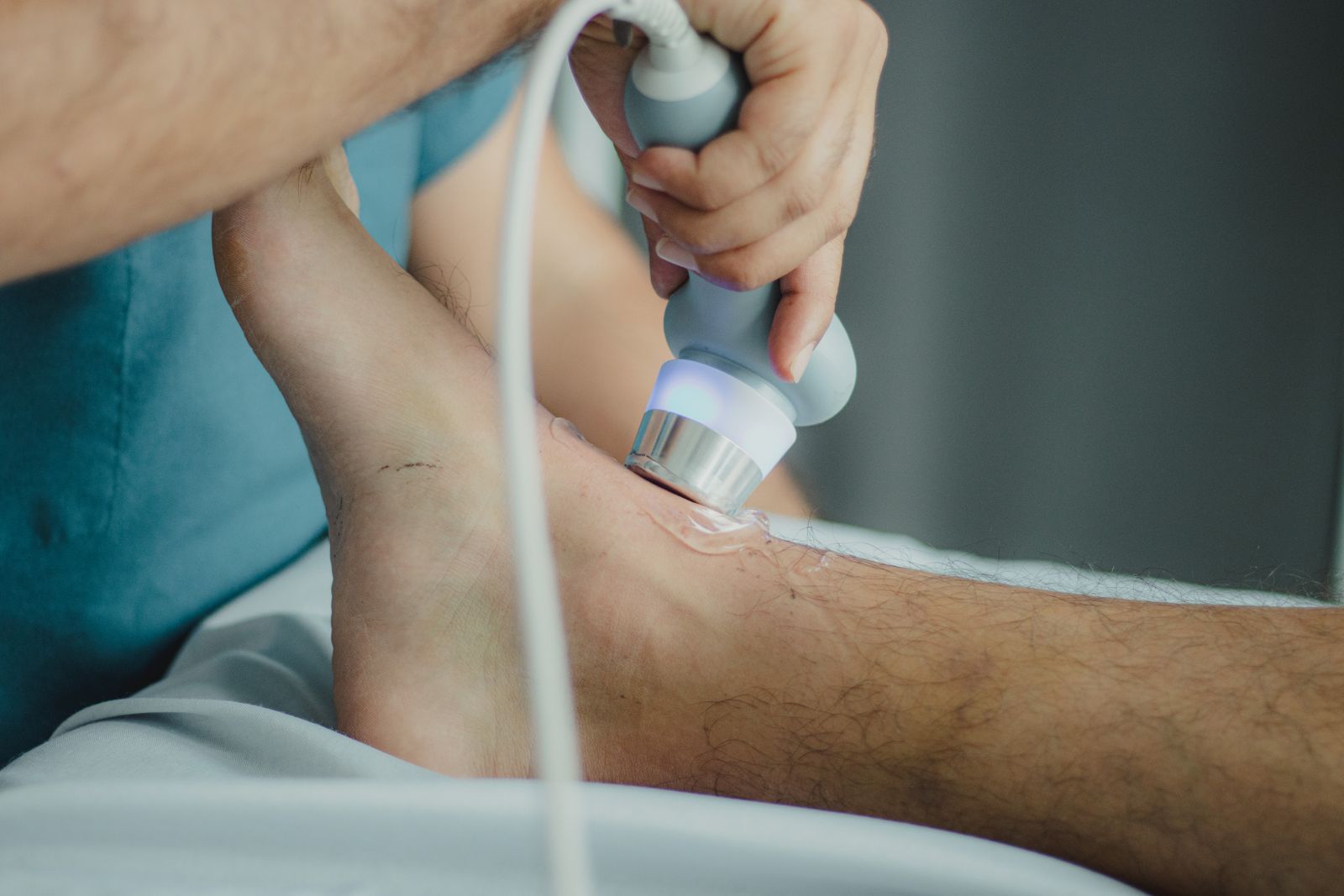
After endovenous laser, most patients walk out and return to their activities within a few days. Mild discomfort, bruising and a cord-like feeling along the treated vein are expected during the first weeks. Walking, following the compression instructions and attending the control ultrasound are the keys. Serious complications are uncommon, but severe pain or sudden leg swelling, shortness of breath or chest pain need immediate attention.
- Same day, week and month
- Home care
- Warning signs
Why recovery is usually quick
Endovenous laser closes the vein from the inside with an ultrasound-guided fiber under local anesthesia, without removing it. In the CLASS trial, which compared laser, foam and traditional surgery, recovery with laser was faster than with surgery. That is why the NICE guideline ranks it, together with radiofrequency, as the first choice for candidates.
Recovery timeline
| When | What is normal | What to do |
|---|---|---|
| Same day | Walking out; bandage or compression stocking | Walk at home, avoid sitting for long periods |
| Days 2 to 7 | Mild discomfort, bruising, a feeling of tightness | Resume light activities as medically advised |
| Weeks 1 to 2 | A hardened cord along the vein | Control ultrasound to confirm closure |
| Weeks 3 to 6 | Bruising fades; visible varicose veins shrink | Assess whether any branch needs complementary treatment |
Exact timing is set by the doctor according to the number of veins treated and each patient.
What is expected and what is not
Expected
- Bruising and discomfort along the vein (Dermatol Surg 2009)
- A cord-like or tight feeling when stretching the leg
- Mild tingling in a patch of skin
Seek care immediately
- Severe pain or sudden swelling of the calf
- Shortness of breath or chest pain
- Fever, spreading redness or pus
How common are complications
Studies help size the risks with real data:
- Tingling or numbness (paresthesia): between 2.5% and 7.3% in small studies (2022 review) and 6.3% in the Mexican series of 158 limbs (Rev Mex Angiol 2023). It usually improves over time.
- Deep venous thrombotic events: about 1.7% in a meta-analysis of 52 studies and over 16,000 patients (Healy et al., 2018).
- Pulmonary embolism: about 0.1% in the same analysis.
That is why the control ultrasound is not a formality: it confirms the vein has closed and rules out thrombosis.
Home care
- Walk from day one. It activates the calf muscle pump and helps circulation.
- Compression as instructed. The type and duration are set by the doctor.
- Avoid sitting or standing still for hours. The IMSS guideline recommends calf exercises when sitting for more than 5 hours.
- Intense exercise and direct heat: resume them when the doctor approves.
- Attend the ultrasound check-up on the scheduled date.
When are results visible?
Relief from heaviness and pain is usually noticed in the first weeks. Visible varicose veins shrink gradually as the closed vein is reabsorbed. Some superficial branches may need complementary treatment, which guidelines anticipate (ESVS 2022).
Venous disease is chronic. Even if the treated vein stays closed, new varicose veins can appear over the years, so regular follow-up is recommended.
Travel and work
Many patients return to office work within a few days. For long flights or road trips, it is worth agreeing the date and preventive measures with the specialist, such as walking during the journey and wearing compression, especially in the first weeks.
Myth and fact
Myth: “You need complete bed rest.”
Fact: The opposite: walking from day one is part of recovery.
Myth: “The hardened cord is a serious complication.”
Fact: It is the closed vein being reabsorbed and usually eases within weeks.
Myth: “If it does not hurt, the check-up is unnecessary.”
Fact: The control ultrasound confirms closure and rules out thrombosis, even without discomfort.
Myth: “After laser, varicose veins never come back.”
Fact: Venous disease is chronic and new varicose veins can appear.
Thinking about treating your varicose veins?
In an assessment we explain what your recovery would look like based on the number of veins and your daily activity.
Book an assessmentFrequently asked questions
How many days off work will I need?
Many patients resume activities within a few days; the exact time depends on the case and is set by the doctor.
Can I shower the same day?
Instructions on showering and compression are given by the doctor at the end of the procedure.
When can I exercise?
Walking from day one; intense exercise once the specialist approves after the check-up.
Is it normal to feel a cord in my leg?
Yes, it is common and corresponds to the treated vein; it usually eases within weeks.
What is the risk of thrombosis?
About 1.7% deep thrombotic events according to a meta-analysis of over 16,000 patients (Healy, 2018).
Do I need a follow-up visit?
Yes. The control ultrasound confirms vein closure and rules out thrombosis.
Keep reading
Downloadable quick guide. Day-by-day recovery, home care and warning signs in one handy image.
Download infographic (PNG)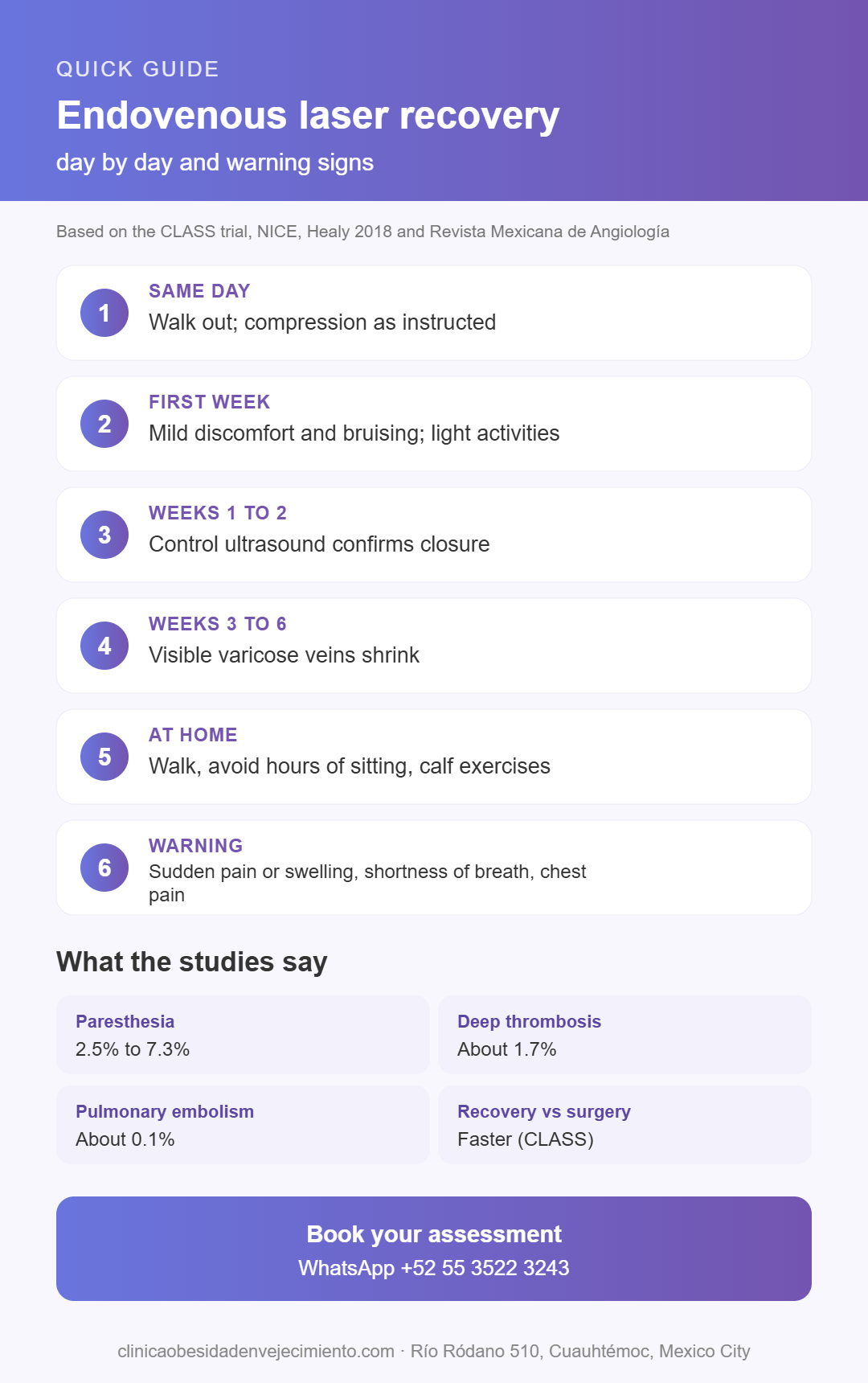
Sources
- Brittenden J, et al. A randomized trial comparing treatments for varicose veins (CLASS). N Engl J Med. 2014;371:1218-27. NIHR summary
- National Institute for Health and Care Excellence. Varicose veins: diagnosis and management (CG168). NICE
- Healy DA, et al. Thrombotic events following endovenous thermal ablation of the great saphenous vein: systematic review and meta-analysis. Eur J Vasc Endovasc Surg. 2018. PubMed
- Kettenhofen-Jiménez SE, et al. Endovenous laser ablation: short-term complications. Rev Mex Angiol. 2023;51(3). SciELO Mexico
- Endovenous laser ablation using laser systems emitting at wavelengths over 1900 nm: a systematic review. 2022. PubMed
- Endovenous laser ablation-induced complications: review of the literature and new cases. Dermatol Surg. 2009. PubMed
- Instituto Mexicano del Seguro Social. Clinical Practice Guideline: Chronic Venous Insufficiency (IMSS-175-09). IMSS
- ESVS 2022 Clinical Practice Guidelines on Chronic Venous Disease. Summary