
Reviewed by clinicaobesidadenvejecimiento.com · Last review:
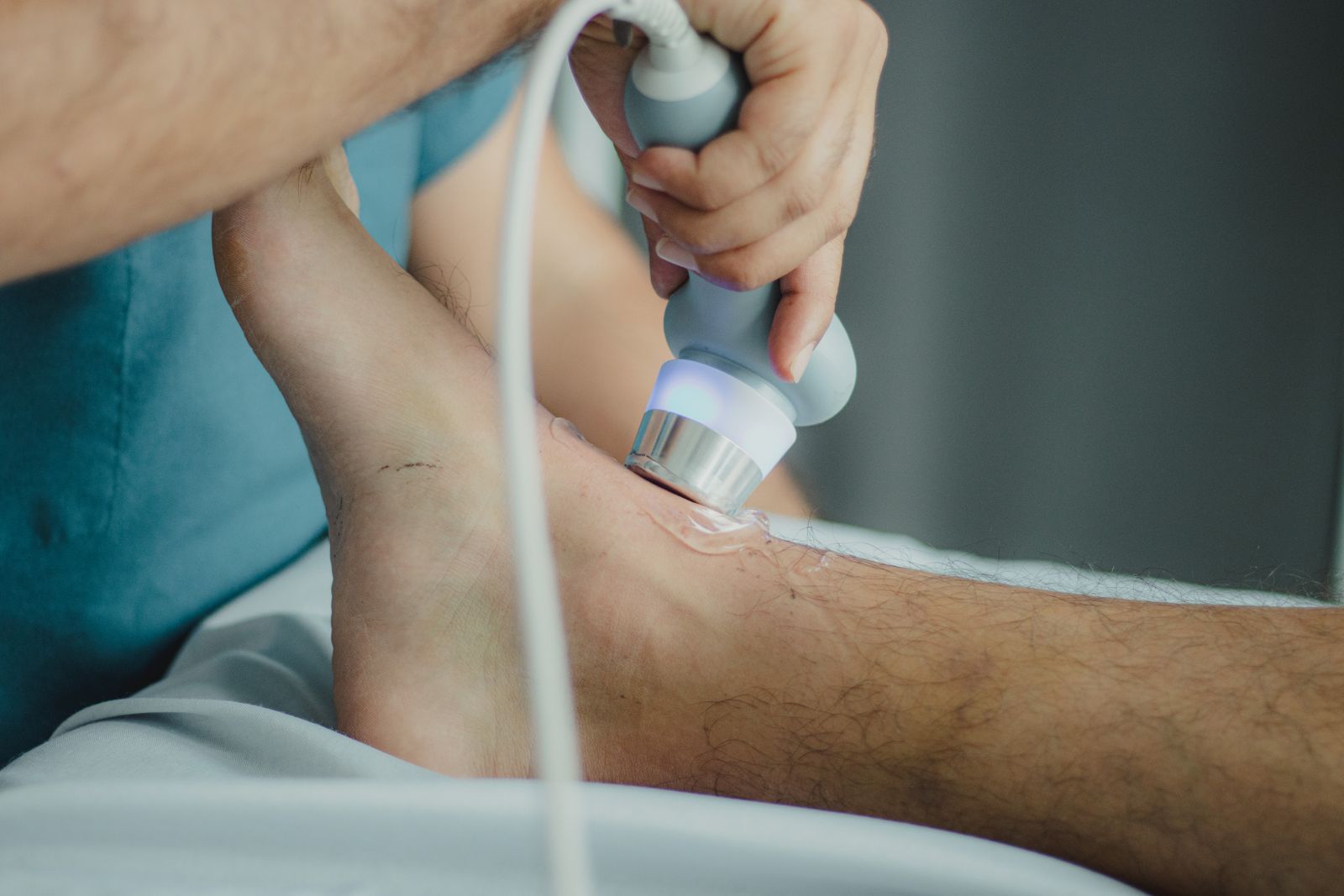
Endovenous laser is a minimally invasive treatment for varicose veins caused by faulty valves in the saphenous veins. It is performed under local anesthesia and ultrasound guidance, without large incisions, and most patients return to their activities within a few days. International guidelines such as NICE in the United Kingdom rank it as the first choice over traditional surgery when the patient is a candidate. Like any medical procedure it has risks, although serious complications are uncommon. Whether it is indicated always depends on an assessment with Doppler ultrasound.
- Local anesthesia
- Ultrasound-guided
- Outpatient
- Backed by ESVS and NICE
- Who it is for
- Saphenous reflux confirmed by Doppler ultrasound (IMSS)
- Duration
- Depends on the number of veins; defined in the assessment (NICE)
- Anesthesia
- Local tumescent, ultrasound-guided (NICE)
- Recovery
- Walking the same day; faster recovery than surgery (CLASS trial)
- Results
- Closure of the diseased vein; first choice in guidelines for candidates (NICE)
What varicose veins and chronic venous insufficiency are
The IMSS Clinical Practice Guideline defines chronic venous insufficiency as a condition in which blood does not return properly from the legs to the heart because of changes in the vein walls and valves, which causes reflux. Varicose veins are one of its most visible signs. In Latin America, a review in the Revista Mexicana de Angiología estimates a prevalence of about 20%.
Symptoms described by IMSS: heaviness, leg pain that worsens in the afternoon, itching, night cramps, fatigue and swelling that improves with rest. They tend to worsen when standing or in the heat and improve when lying down or raising the legs.
Risk factors: older age, family history, long periods standing, obesity, pregnancy, a sedentary lifestyle and certain occupations. The condition is more common in women.
What endovenous laser is and how it works
Varicose veins appear when the valves in the leg veins stop closing properly and blood pools. In many patients the source is the great or small saphenous vein. In endovenous laser, the doctor inserts a thin fiber into the vein under ultrasound guidance. The laser energy heats the vein wall from the inside and closes it, and blood is naturally rerouted through healthy veins. That is why it is classified as endovenous thermal ablation, the same family as radiofrequency. The ESVS 2022 guideline confirms the central role of thermal ablation in treating superficial vein insufficiency.
How it is diagnosed before treatment
The IMSS guideline recommends duplex Doppler ultrasound for accurate diagnosis in treatment candidates, and classifying the disease with the international CEAP scale, which considers clinical signs, cause, affected veins and mechanism. With that information the specialist decides whether the saphenous vein is suitable for laser, whether another technique is better, or whether conservative measures are enough. The same guideline states that these procedures should be performed in qualified units by trained surgeons.
Who is it for?
It is indicated for people with saphenous reflux confirmed by Doppler ultrasound and symptoms or skin changes; some conditions need special assessment.
Usually a candidate
- Varicose veins with great or small saphenous reflux confirmed by Doppler
- Heaviness, pain, swelling or cramps
- Skin changes or venous ulcers
- People looking for an option without open surgery
Requires special assessment
- Active deep vein thrombosis
- Pregnancy
- Significant arterial disease in the legs
- Very tortuous veins or unsuitable diameter
In patients with a venous ulcer, the ESVS 2022 guideline recommends early ablation because it speeds healing and reduces recurrence.
Risks according to the studies
The most common risks are mild and temporary; serious ones, such as thrombosis, are uncommon.
| Effect | Approximate frequency | Source |
|---|---|---|
| Bruising and discomfort along the vein | Common and temporary | Dermatol Surg 2009 |
| Tingling or numbness (paresthesia) | 2.5% to 7.3%; 6.3% in the Mexican study | 2022 review · Rev Mex Angiol 2023 |
| Deep venous thrombotic events | About 1.7% (52 studies, over 16,000 patients) | Healy 2018 |
| Pulmonary embolism | About 0.1% | Healy 2018 |
In Mexico, a study of 158 limbs reported mild complications in about 20% and no deep vein thrombosis or embolism (Rev Mex Angiol 2023). Another Mexican study of 80 patients comparing laser and radiofrequency found no significant differences at 7 and 30 days (Rev Mex Angiol 2021).
Endovenous laser compared with other options
Guidelines rank thermal ablation, such as endovenous laser, as the first choice; foam, surgery and stockings are kept for other cases.
- Thermal ablation (laser or radiofrequency): first choice if the patient is a candidate (NICE CG168, ESVS 2022).
- Ultrasound-guided foam sclerotherapy: an alternative when ablation is not suitable.
- Traditional surgery (stripping): when the above are not suitable.
- Compression stockings: only when no treatment is possible.
Earlier versions of the Cochrane review concluded that laser, radiofrequency and foam are at least as effective as surgery, and in the CLASS trial recovery with laser was faster.
Recovery step by step
Patients walk the same day and most return to their activities within a few days.
- Same day: the patient walks out; bandage or compression stocking as indicated.
- First days: mild discomfort and bruising; walking is encouraged and long sitting avoided.
- First weeks: control ultrasound to confirm closure and rule out thrombosis.
- Following weeks: visible varicose veins shrink; some branches may need complementary treatment.
Seek immediate care for severe pain or sudden leg swelling, shortness of breath or chest pain.
How to care for your veins before and after
The IMSS guideline recommends regular physical activity (especially walking and swimming), calf exercises when sitting for more than 5 hours, avoiding constipation and consulting a doctor before starting hormone therapy. These measures do not replace treatment of the diseased vein, but they help control symptoms and protect the result.
Myth and fact
Myth: “Laser removes varicose veins forever.”
Fact: It closes the diseased vein, but venous disease is chronic and new varicose veins can appear (NICE CG168).
Myth: “It is the same as traditional surgery.”
Fact: It avoids removing the vein and is usually done under local anesthesia; in the CLASS trial recovery was faster.
Myth: “Compression stockings cure varicose veins.”
Fact: NICE reserves them for people who cannot be treated; they relieve symptoms but do not correct reflux.
Myth: “Any vein can be treated with laser.”
Fact: Only those the Doppler shows to be suitable (NICE CG168).
Myth: “It has no risks.”
Fact: It has uncommon risks such as thrombosis or paresthesia, documented in systematic reviews.
Do your varicose veins bother you?
The first step is a medical assessment with Doppler ultrasound to find out whether endovenous laser is right for you.
Book an assessmentFrequently asked questions
Does endovenous laser hurt?
It is performed under local anesthesia. Mild discomfort along the vein for a few days afterwards is common.
How long does the procedure take?
It depends on how many veins are treated; the doctor defines it after the Doppler scan.
Can I work the next day?
Many patients resume activities within a few days, but the exact time is set by the doctor.
Do I need tests beforehand?
Yes. Venous Doppler ultrasound is essential to know whether laser is suitable.
Can both legs be treated?
It is possible; it is decided according to the assessment and the number of affected veins.
Can varicose veins come back?
Yes. Venous disease is chronic, so regular follow-up is recommended.
What is the CEAP classification?
The international scale specialists use to describe venous disease by its signs, cause, affected veins and mechanism. IMSS recommends it.
Is endovenous laser performed in Mexico?
Yes. Mexican specialists have published experience in the Revista Mexicana de Angiología with favorable short-term safety results.
Keep reading
Downloadable quick guide. The essentials of endovenous laser in one image: what it treats, preparation, recovery and risks according to the studies.
Download infographic (PNG)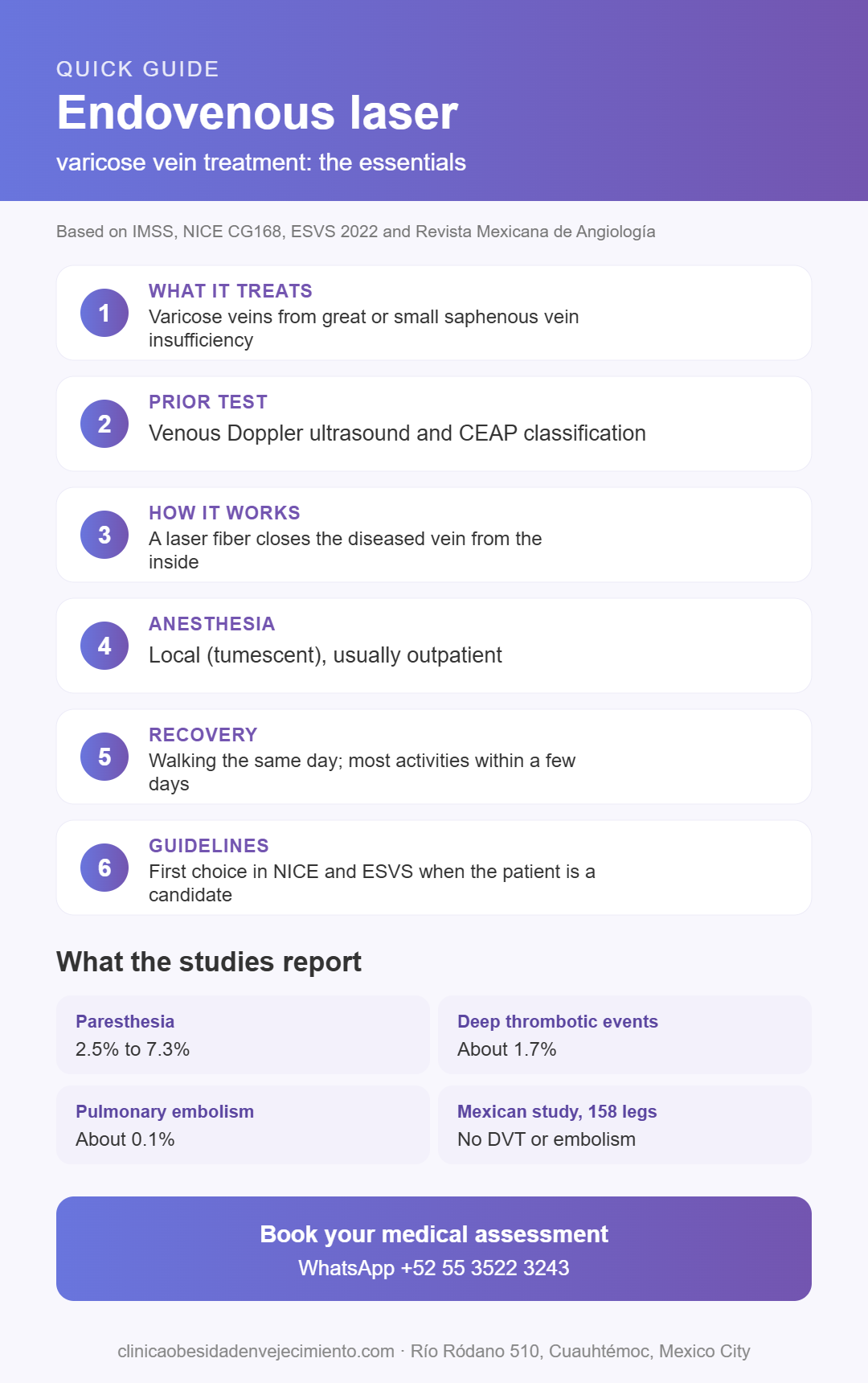
Sources
- Instituto Mexicano del Seguro Social. Clinical Practice Guideline: Chronic Venous Insufficiency (IMSS-175-09). IMSS
- Kettenhofen-Jiménez SE, et al. Endovenous laser ablation: short-term complications. Rev Mex Angiol. 2023;51(3). SciELO Mexico
- Lozano-Balderas G, et al. Radiofrequency vs. 1470 nm laser ablation for chronic venous disease. Rev Mex Angiol. 2021;49(4). SciELO Mexico
- Revista Mexicana de Angiología. Chronic venous disease, 2018. Medigraphic
- De Maeseneer MG, et al. ESVS 2022 Clinical Practice Guidelines on Chronic Venous Disease. Eur J Vasc Endovasc Surg. 2022;63(2):184-267. Summary
- National Institute for Health and Care Excellence. Varicose veins: diagnosis and management (CG168). NICE
- Brittenden J, et al. A randomized trial comparing treatments for varicose veins (CLASS). N Engl J Med. 2014;371:1218-27. NIHR summary
- Whing J, et al. Interventions for great saphenous vein incompetence. Cochrane Database Syst Rev. 2021. Cochrane
- Healy DA, et al. Thrombotic events following endovenous thermal ablation: systematic review and meta-analysis. Eur J Vasc Endovasc Surg. 2018. PubMed
- Endovenous laser ablation using laser systems over 1900 nm: a systematic review. 2022. PubMed
- Endovenous laser ablation-induced complications: review of the literature. Dermatol Surg. 2009. PubMed