
Reviewed by clinicaobesidadenvejecimiento.com · Last review:
Recovery after biopolymer removal depends on the area, the amount of material removed and whether reconstruction was done. In a series of 35 patients who had gluteal surgery, 42.9% had no complications; the most frequent was seroma (40%), resolved with drainage, followed by wound opening (28.6%) and infection (14.3%), treated with oral antibiotics. Close follow-up, compression and medical management of inflammation are part of treatment. Several sessions are sometimes needed.
- Recovery stages
- Real complication rates
- Aftercare and follow-up
What affects recovery
No two cases are the same. Recovery varies with:
- The treated area: buttocks, legs, breasts or face.
- The amount and depth of material shown on MRI.
- The condition of the tissue before surgery, which is why prior medical management matters (Hospital General de México).
- Whether reconstruction with the patient’s own tissue was done to correct depressions.
Coiffman recommends resecting limited areas, and in some cases removal is done in several sessions (JPRAS Open 2025).
Recovery stages
- First days: swelling, discomfort and, depending on the case, drains. Relative rest, walking at home and following wound-care instructions.
- First weeks: wound checks, drain removal and monitoring for fluid build-up (seroma). Compression if indicated.
- First months: swelling gradually subsides and the contour is assessed. A decision is made on whether another session or reconstruction is needed.
- Long term: medical follow-up, because some material may remain and need monitoring.
Complications and how common they are
| Complication | Frequency | How it was resolved |
|---|---|---|
| Seroma (fluid collection) | 40% | Drainage |
| Wound opening | 28.6% | Wound care and closure as needed |
| Wound infection | 14.3% | Oral antibiotics |
| No complications | 42.9% | Not applicable |
Data from the series of 35 patients with open gluteal removal published in JPRAS Open (2025). Knowing these figures helps set realistic expectations: complications are common, but in that series they were resolved with standard care.
Home care
Do
- Follow wound-care and compression instructions
- Walk gently from the first days
- Take the prescribed medication
- Attend every follow-up appointment
Report immediately
- Fever or spreading redness
- Pus or a bad smell from the wound
- Rapid swelling of the area
- Pain that gets worse instead of better
Why follow-up is part of treatment
Filler substance disease can remain active even after much of the material is removed. The Hospital General de México describes a multidisciplinary approach in which medical management continues after surgery to control inflammation. Follow-up catches seromas early, checks healing and helps decide whether another stage of treatment is advisable.
Laser technology is used as support during removal; published evidence on its specific use is limited (2025 review), so it does not replace surgical technique or follow-up.
Prevention: do not inject again
COFEPRIS reminds the public that filler substances are high risk and recommends seeing only accredited professionals, checking the surgeon’s registration with the Mexican Council of Plastic, Aesthetic and Reconstructive Surgery and reporting places that apply them.
Myth and fact
Myth: “After surgery, nothing else needs to be done.”
Fact: Follow-up and medical management continue (Hospital General de México).
Myth: “If fluid builds up, the surgery failed.”
Fact: Seroma was the most frequent complication and was resolved with drainage (JPRAS Open 2025).
Myth: “Everything is solved in one surgery.”
Fact: Sometimes several sessions are needed depending on the amount of material.
Myth: “Laser eliminates the risk of complications.”
Fact: It is a supporting tool; evidence on its specific use is limited.
Considering biopolymer removal?
In an assessment we review your tests, explain the plan and what your recovery would look like.
Book an assessmentFrequently asked questions
How long does recovery take?
It depends on the area and amount of material; swelling subsides gradually over weeks to months.
What is a seroma?
A fluid collection under the skin. It was the most frequent complication in the 35-patient series and was resolved with drainage.
Will I need another surgery?
In some cases several sessions or a reconstruction are planned.
Do I need a compression garment?
It is indicated depending on the area and technique.
When can I return to my activities?
The doctor decides based on progress and the treated area.
Can I have fillers again?
COFEPRIS recommends avoiding filler substances and seeing only accredited professionals.
Keep reading
Downloadable quick guide. Recovery stages, complication rates and aftercare in one image.
Download infographic (PNG)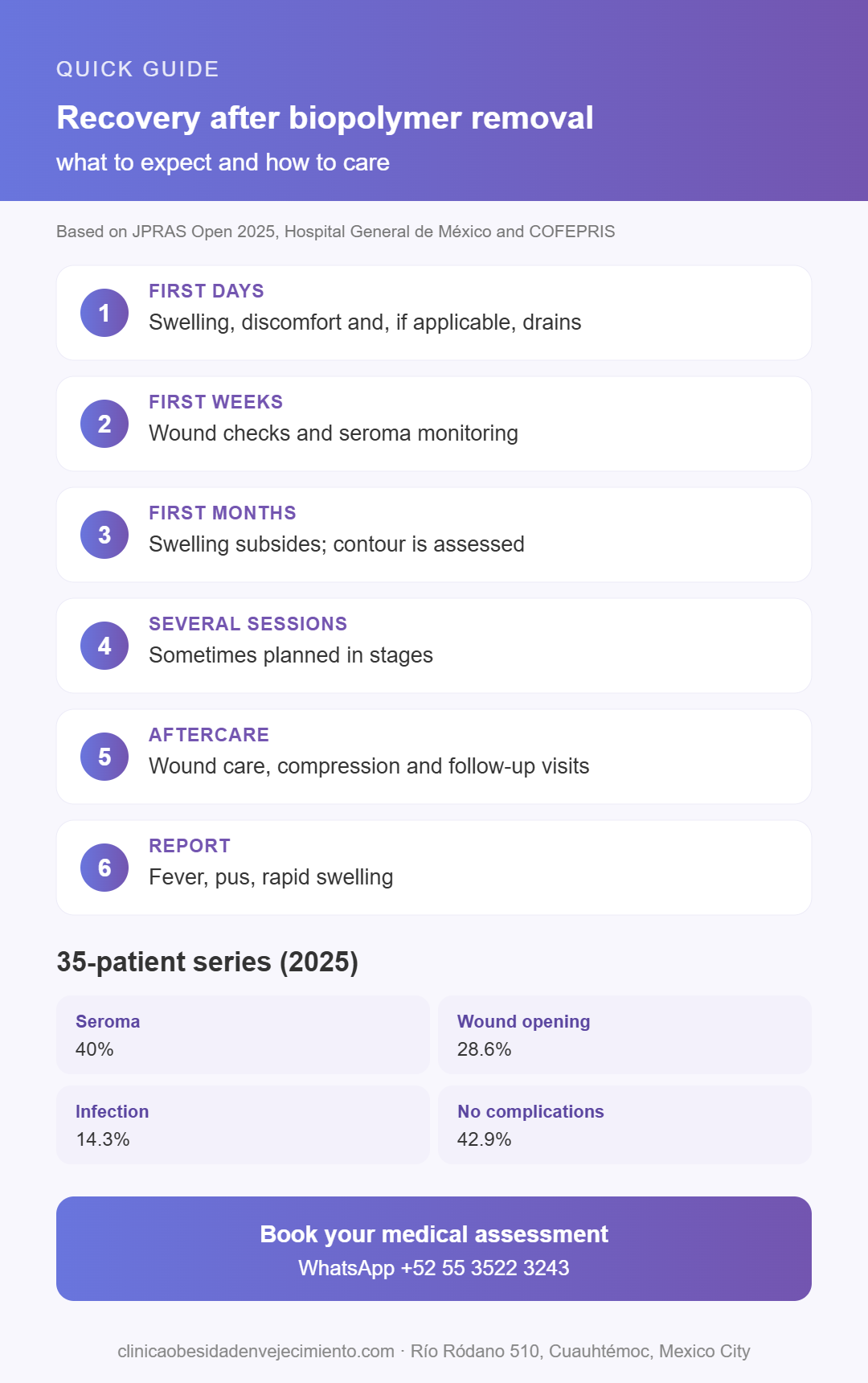
Sources
- Eusse Llanos JC, Posada López S. Paramedian open approach for gluteal biopolymers removal: a case series of 35 patients. JPRAS Open. 2025;45:425-435. PubMed Central
- Gordillo-Hernández J, et al. Multidisciplinary approach to filler substance disease. Hospital General de México. Cir Plast Iberolatinoam. 2013;39(3). SciELO
- Coiffman F. Iatrogenic allogenosis: a new disease. Cir Plast Iberolatinoam. 2008;34(1). SciELO
- Foreign body granulomas related to cosmetic fillers: a systematic review. 2025. PubMed Central
- COFEPRIS. Statement 96/2023 on filler substances. gob.mx