
Reviewed by clinicaobesidadenvejecimiento.com · Last review:

Biopolymers or filler substances (liquid silicone, oils, paraffin, polyacrylamide) can cause a disease known as iatrogenic allogenosis. Its most common symptoms are swelling, hardening, lumps, pain and color changes in the injected area, and in some cases joint pain or reactions in other organs. They can appear anywhere from weeks to 30 years after the injection. COFEPRIS, the Mexican health regulator, considers these substances a high health risk. If anything changes, the right step is a medical assessment with imaging.
- Local and general symptoms
- When they appear
- What to do
- Who it is for
- People with complications from filler substances (COFEPRIS)
- Duration
- Depends on the area and amount; sometimes in several sessions (JPRAS Open 2025)
- Anesthesia
- Set by the medical team according to the extent of surgery (Hospital General de México)
- Recovery
- Weeks to months; seroma was the most frequent complication, 40% (JPRAS Open 2025)
- Results
- Remove what is safe and control symptoms; 100% is not always possible (Coiffman 2008)
What filler substance disease is
In 2023, COFEPRIS warned about the use of non-absorbable filler substances in cosmetic procedures: liquid or gel silicone, petroleum jelly, paraffin, polyacrylamide, vegetable or motor oils, guaiacol and beeswax, among others. The Mexico City Health Protection Agency also issued a risk notice.
Plastic surgeon Felipe Coiffman proposed the term iatrogenic allogenosis for the disease these materials cause in the body (Coiffman, 2008): the body recognizes the substance as foreign and reacts with chronic inflammation.
When symptoms appear
One of the most important features is latency. In the experience of the Hospital General de México, with 128 patients, symptoms appeared anywhere from weeks to 30 years after the injection. So anyone who had a substance injected to add volume, even long ago and without discomfort, should watch for any change.
Symptoms in the injected area
The most frequent symptoms appear where the material was injected.
Most frequent
- Swelling, redness or warmth
- Hardening of the area
- Lumps, nodules or irregularities
- Pain to the touch or when sitting
Signs of progression
- Skin color changes (dark or reddish patches)
- Migration of the material to other areas
- Ulcers or wounds that do not heal
- Fluid or material leaking through the skin
The most affected areas are the buttocks, legs, breasts and face, where these substances are most often injected.
Symptoms elsewhere in the body
The reaction does not always stay at the injection site. The Hospital General de México series also describes:
- Joint and muscle pain.
- Persistent fatigue and malaise.
- General inflammatory reactions.
- Kidney, liver or lung problems in severe cases.
If fever, shortness of breath or rapidly spreading swelling appear, go to the emergency room.
How severity is classified
Severity is classified in stages, from no symptoms to general involvement.
| Stage | What is seen | Approach |
|---|---|---|
| No symptoms | Material present, no discomfort | Monitoring and assessment |
| Mild | Occasional swelling or nodules | Medical management |
| Moderate | Persistent swelling, hardening, pain | Medical management and consider localized removal |
| Severe | Ulcers, migration, general involvement | Multidisciplinary care |
Guidance summary based on the 250-patient series (2022) and the Hospital General de México, which propose treatment by clinical stage.
What to do if you suspect biopolymers
If biopolymers are suspected, apply nothing else and seek a medical assessment with imaging.
- Do not inject or apply anything else in the area.
- Gather information: what was applied, when, where and how many sessions.
- Medical assessment with a specialist familiar with filler substance disease.
- Imaging, especially MRI, to locate the material.
- Personalized plan: medical management and, when appropriate, removal in localized areas.
COFEPRIS recommends seeing only accredited professionals and checking that the surgeon is registered with the Mexican Council of Plastic, Aesthetic and Reconstructive Surgery.
Myth and fact
Myth: “If many years have passed, there is no risk.”
Fact: Symptoms can appear up to 30 years later (Hospital General de México).
Myth: “If it does not hurt, there is nothing there.”
Fact: The material can be present without symptoms; MRI can locate it (Hospital General de México).
Myth: “They are safe if applied by someone experienced.”
Fact: COFEPRIS considers them high risk regardless of who applies them.
Myth: “The symptoms are only cosmetic.”
Fact: There can be general reactions and damage to other organs (Hospital General de México).
Have you had a substance injected to add volume?
A medical assessment with imaging shows where the material is and what your options are.
Book an assessmentFrequently asked questions
What are biopolymers?
Unauthorized substances injected to add volume, such as liquid silicone, oils or paraffin (COFEPRIS).
How long do they take to cause symptoms?
From weeks to decades after the injection.
Which areas are most affected?
Buttocks, legs, breasts and face.
Can it affect other organs?
In severe cases kidney, liver or lung problems have been described (Hospital General de México).
Which test confirms the material?
MRI is the test that best shows its extent.
What should I avoid?
Injecting any other substance in the area and self-medicating without an assessment.
Keep reading
Downloadable quick guide. Local and general symptoms, when they appear and what to do, in one image.
Download infographic (PNG)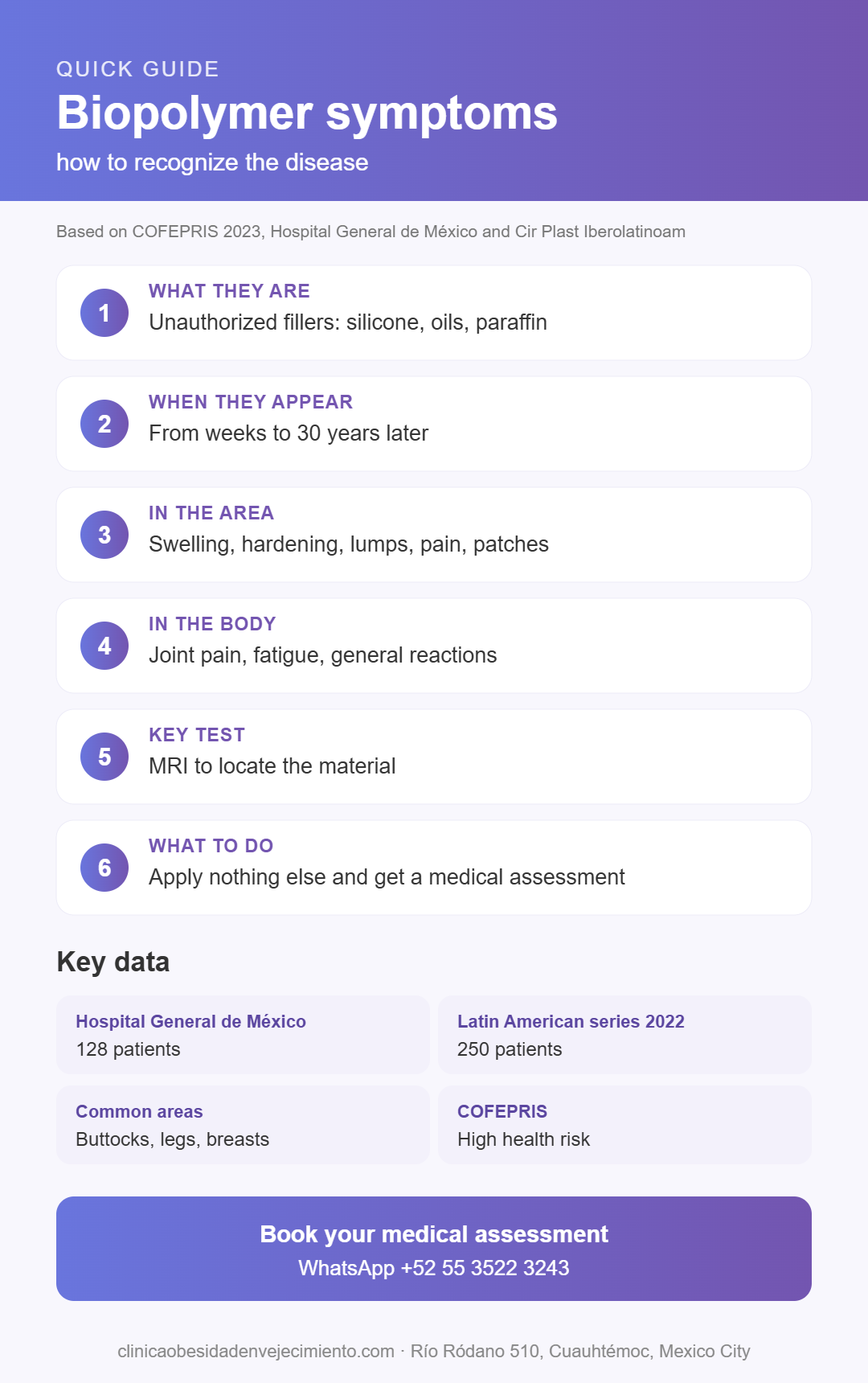
Sources
- COFEPRIS. Filler substances used in cosmetic procedures pose a high health risk. Statement 96/2023. gob.mx
- Mexico City Health Protection Agency. Risk notice on filler substances. AGEPSA CDMX
- Gordillo-Hernández J, et al. Multidisciplinary approach to filler substance disease. Hospital General de México. Cir Plast Iberolatinoam. 2013;39(3). SciELO
- Coiffman F. Iatrogenic allogenosis: a new disease. Cir Plast Iberolatinoam. 2008;34(1). SciELO
- Allogenosis from biomaterials, our experience. Cir Plast Iberolatinoam. 2022. SciELO