
Reviewed by clinicaobesidadenvejecimiento.com · Last review:
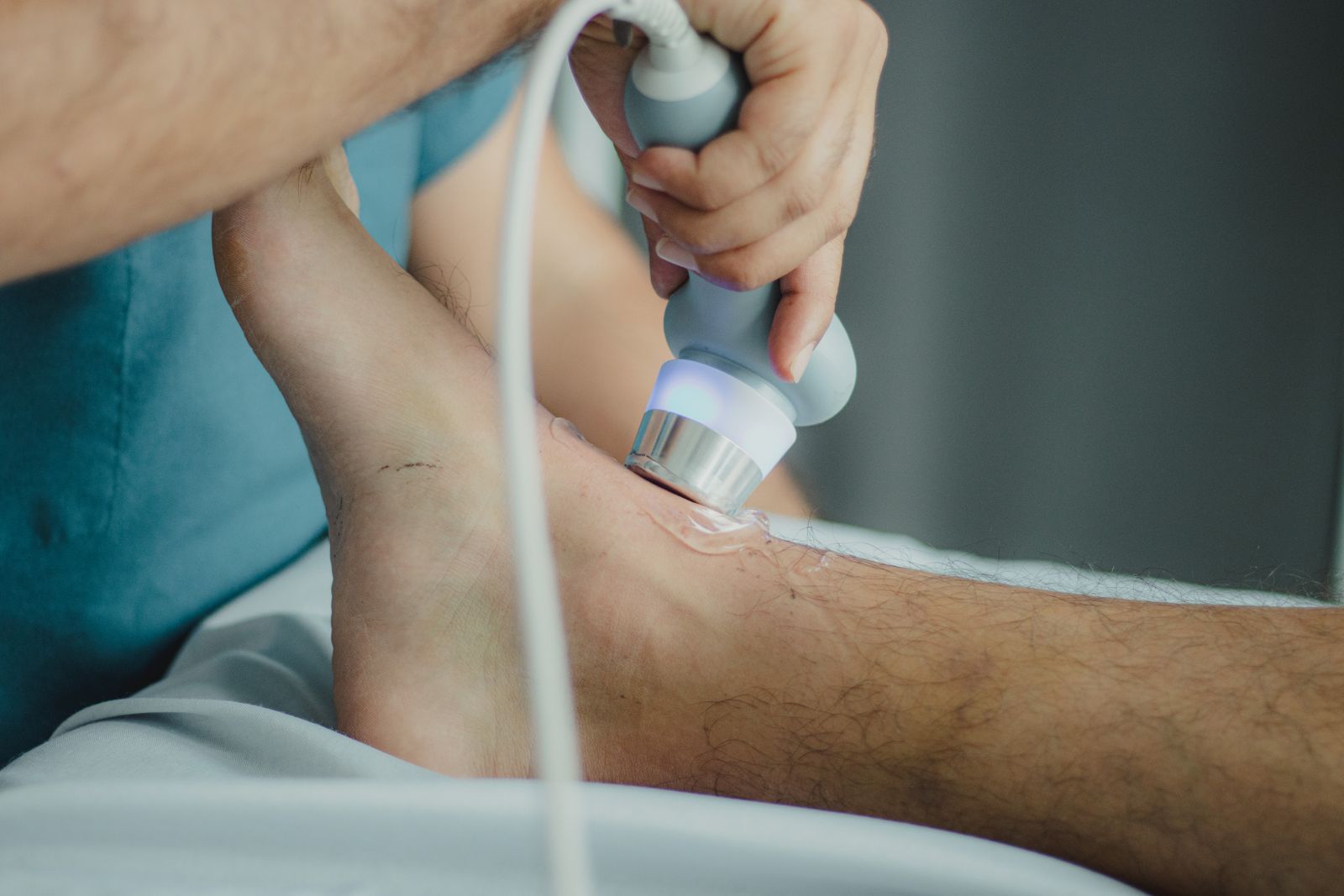
Varicose veins are treated when they cause symptoms (heaviness, pain, swelling, cramps), when skin changes or ulcers appear, or when Doppler ultrasound confirms reflux in the saphenous veins. Guidelines from NICE and the European Society for Vascular Surgery rank thermal ablation, such as endovenous laser, as the first choice for candidates. Waiting is not always best: venous insufficiency is chronic and can progress. The decision is made with a medical assessment and a Doppler scan, not just by how the legs look.
- Warning signs
- Doppler and CEAP scale
- NICE, ESVS and IMSS guidelines
- Who it is for
- Saphenous reflux confirmed by Doppler ultrasound (IMSS)
- Duration
- Depends on the number of veins; defined in the assessment (NICE)
- Anesthesia
- Local tumescent, ultrasound-guided (NICE)
- Recovery
- Walking the same day; faster recovery than surgery (CLASS trial)
- Results
- Closure of the diseased vein; first choice in guidelines for candidates (NICE)
Varicose veins are not just a cosmetic issue
The IMSS Clinical Practice Guideline describes chronic venous insufficiency as impaired return of blood from the legs to the heart, caused by damage to the vein walls and valves. When the valves fail to close, blood flows backwards (reflux), the veins dilate and varicose veins appear.
It is a common condition: a review in the Revista Mexicana de Angiología estimates a prevalence of about 20% in Latin America. That is why it is worth telling apart a visible vein that is only a cosmetic concern from venous disease that needs treatment.
Signs that an assessment is worthwhile
The IMSS guideline lists the symptoms that point to venous insufficiency. If they keep coming back, it makes sense to see a specialist:
Symptoms
- Heavy, tired legs, especially in the afternoon
- Pain that worsens when standing or in the heat
- Night cramps and itching
- Ankle swelling that improves with rest
Skin signs
- Dark patches on the lower leg
- Hardened skin or eczema
- Wounds that are slow to heal (venous ulcer)
- Veins that bleed easily
Skin changes and ulcers indicate more advanced disease. In these cases, the ESVS 2022 guideline recommends treating reflux early because it speeds healing and reduces recurrence.
What Doppler ultrasound checks
Treatment is not decided by how the legs look. The IMSS guideline recommends duplex Doppler ultrasound to confirm the diagnosis in treatment candidates. The scan shows:
- Whether there is reflux and in which veins (great saphenous, small saphenous or branches).
- The diameter and course of the vein, which determine whether the laser fiber fits.
- Whether there is thrombosis or a problem in the deep veins.
With that result, the specialist classifies the disease using the international CEAP scale, which the same guideline recommends.
The CEAP scale made simple
The CEAP scale grades venous disease from C0 to C6 according to what is seen on the leg.
| Class | What is seen | What it usually means |
|---|---|---|
| C0 to C1 | No visible signs or spider veins | Assessment if there are symptoms; often general measures |
| C2 | Varicose veins | Doppler to look for reflux; treatment if a candidate |
| C3 | Swelling (edema) | Treat the venous cause when Doppler confirms it |
| C4 | Skin changes | Higher treatment priority |
| C5 to C6 | Healed or active ulcer | Early treatment of reflux according to ESVS |
Source: CEAP classification recommended by the IMSS and the ESVS.
When endovenous laser is the first choice
The NICE guideline (CG168) recommends this order for people with symptomatic varicose veins and confirmed reflux: first, endovenous thermal ablation (laser or radiofrequency); if unsuitable, ultrasound-guided foam sclerotherapy; and if that is also unsuitable, traditional surgery. Compression stockings are reserved for people who cannot receive treatment.
There is published experience in Mexico: a study of 158 limbs treated with endovenous laser reported mild complications in about 20% and no cases of deep vein thrombosis or embolism (Revista Mexicana de Angiología, 2023).
What if I wait?
Venous disease is chronic. Waiting may be reasonable if there are no symptoms and no significant reflux, always with venous relief measures. But when there are persistent symptoms, swelling or skin changes, delaying the assessment lets the disease move into higher CEAP classes. Guidelines recommend deciding with the Doppler result in hand.
In the meantime, the IMSS guideline advises regular physical activity (especially walking and swimming), calf exercises when sitting for more than 5 hours, avoiding constipation and consulting a doctor before starting hormone therapy.
When it is not the right time
Some conditions, such as active thrombosis or pregnancy, mean treatment is postponed or assessed separately.
Can be treated
- Confirmed great or small saphenous reflux
- Symptoms that affect daily life
- Skin changes or a venous ulcer
Postponed or assessed separately
- Active deep vein thrombosis
- Pregnancy
- Significant arterial disease in the legs
Myth and fact
Myth: “If they do not hurt, varicose veins need no check-up.”
Fact: Reflux and skin changes can exist with few symptoms; the Doppler scan is what defines treatment.
Myth: “You have to wait for them to get worse before treating.”
Fact: The NICE and ESVS guidelines recommend treating symptomatic candidates without waiting for complications.
Myth: “Compression stockings cure them.”
Fact: They relieve symptoms but do not correct reflux; NICE reserves them for people who cannot be treated (NICE CG168).
Myth: “They are only treated for looks.”
Fact: Varicose veins are part of a chronic venous disease described by the IMSS.
Are your legs sending you signals?
An assessment with Doppler ultrasound shows whether your varicose veins need treatment and whether endovenous laser is the right option.
Book an assessmentFrequently asked questions
At what age are varicose veins treated?
There is no fixed age. They are treated when there are symptoms or reflux confirmed by Doppler and the patient is a candidate.
Are spider veins also treated with endovenous laser?
No. Endovenous laser treats saphenous veins with reflux; spider veins require other techniques.
Does pregnancy make varicose veins worse?
Pregnancy is a risk factor described by the IMSS. Laser treatment is postponed until after pregnancy.
What if I already have an ulcer?
The ESVS 2022 guideline recommends treating reflux early because it speeds healing.
Do I need a test before the consultation?
The specialist orders the Doppler ultrasound; it is the basis for deciding treatment.
Is endovenous laser performed in Mexico?
Yes. Mexican specialists have published series with favorable short-term safety results (Rev Mex Angiol 2023).
Keep reading
Downloadable quick guide. Warning signs, what the Doppler checks and when laser is the first choice, in a single image.
Download infographic (PNG)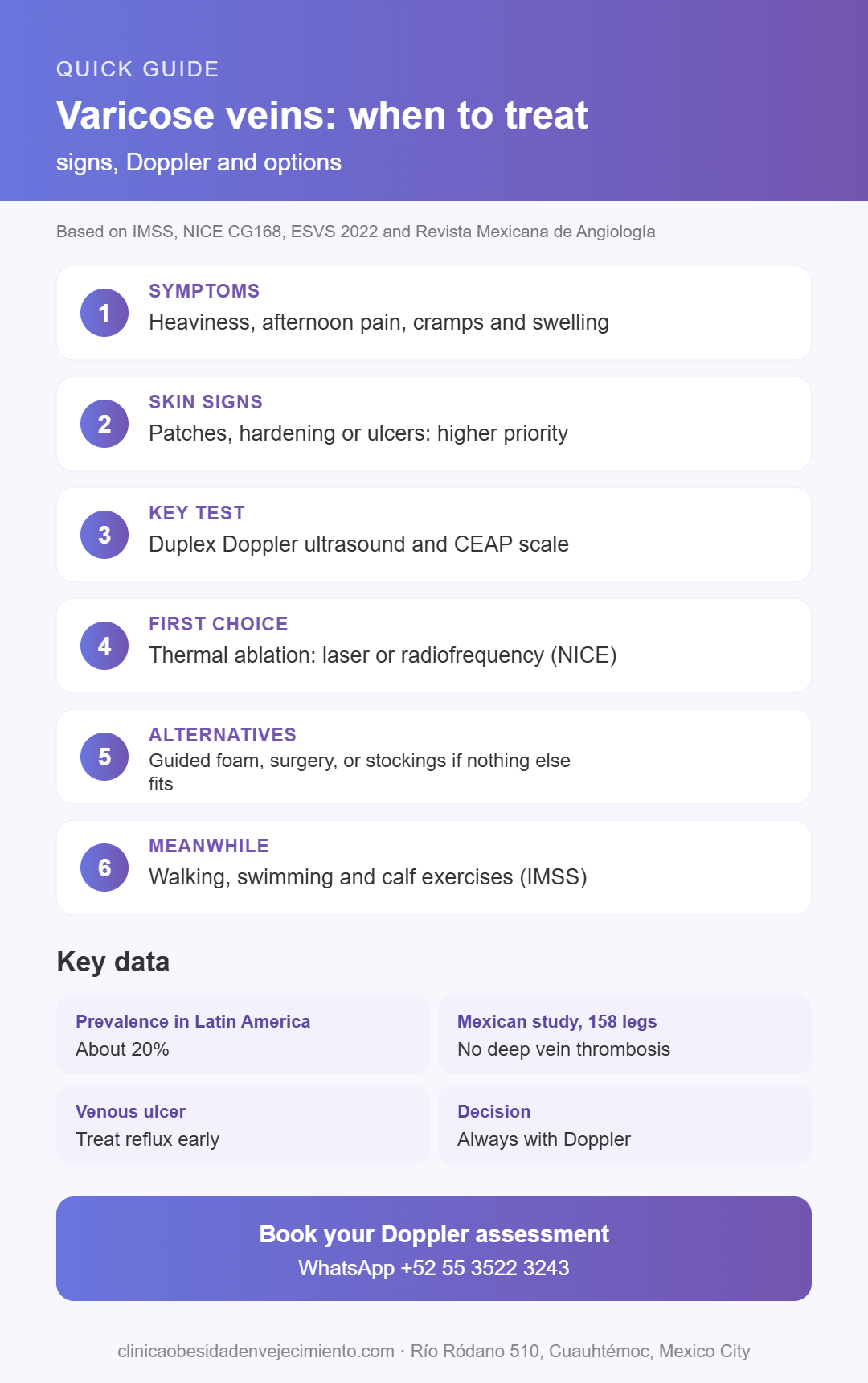
Sources
- Instituto Mexicano del Seguro Social. Clinical Practice Guideline: Chronic Venous Insufficiency (IMSS-175-09). IMSS
- National Institute for Health and Care Excellence. Varicose veins: diagnosis and management (CG168). NICE
- De Maeseneer MG, et al. ESVS 2022 Clinical Practice Guidelines on Chronic Venous Disease. Summary
- Kettenhofen-Jiménez SE, et al. Endovenous laser ablation: short-term complications. Rev Mex Angiol. 2023;51(3). SciELO Mexico
- Revista Mexicana de Angiología. Chronic venous disease, 2018. Medigraphic