
Reviewed by clinicaobesidadenvejecimiento.com · Last review:

A breast lift, or mastopexy, is surgery that raises the bust, repositions the areola and removes excess skin to restore a firm shape. It is indicated according to the degree of sagging, measured by the position of the nipple relative to the fold under the breast (Regnault classification). It can be done alone or with implants if volume is also desired. The laser does not lift the bust: it supports skin quality. In a study by Mexico City surgeons with 149 patients, the highest satisfaction came from a well-indicated lift alone.
- Degrees of sagging
- Step-by-step technique
- The real role of the laser
What a breast lift is
Over time, pregnancy, breastfeeding and weight changes stretch the skin and supporting tissue of the bust, and the breast descends. A breast lift corrects that sagging: it raises the gland, repositions the nipple-areola complex at a natural height and removes excess skin. The American Society of Plastic Surgeons describes it as a procedure that can be combined with augmentation or reduction according to each patient’s needs.
How breast sagging is measured
The Regnault classification is the one plastic surgeons use most to define the degree of sagging (ptosis) and choose the technique:
| Grade | What it means | Usual approach |
|---|---|---|
| Grade 1 (mild) | The nipple is level with the fold under the breast | Techniques with shorter scars |
| Grade 2 (moderate) | The nipple is below the fold but above the lowest point of the breast | Lift according to excess skin |
| Grade 3 (severe) | The nipple is at the lowest point of the breast | Lift with greater repositioning |
| Pseudoptosis | The nipple is well positioned but the tissue drops below it | Individual assessment |
How it is done step by step
- Assessment: degree of sagging, skin quality, current and desired volume, general health and expectations.
- Surgical plan: lift alone or combined with implants, and type of incision according to the degree of sagging.
- Surgery: the gland is raised, the areola repositioned and excess skin removed.
- Laser support: the clinic uses laser technology as a complement for skin quality.
- Follow-up: post-operative checks until the final shape settles.
What the laser adds and what it does not
What it adds
- Support for skin quality and firmness
- A complement within the surgical plan
- Intralesional diode lasers show favorable firmness results (2024 review)
What it does not do
- It does not lift the bust on its own
- It does not replace surgical technique
- Most laser studies focus on the face and neck
What the evidence in Mexico says
A study by plastic surgeons in Mexico City (Centro Médico ABC and Hospital General de México) analyzed 149 patients by technique (Cirugía Plástica, 2022):
- Lift alone: 75 of 75 patients reported high aesthetic satisfaction.
- Lift with augmentation: 16 of 26 reached that level.
- Lift with implant exchange: 17 of 48.
The complications that varied most by technique were wound opening, asymmetry and seroma. The practical takeaway: choosing the right technique for the degree of sagging matters most.
Who is a good candidate
Usually a candidate
- Sagging after pregnancy, breastfeeding, weight change or age
- Stable weight
- Good general health and no smoking
- Realistic expectations about scars and shape
Better to wait or assess separately
- Planning a pregnancy soon
- Ongoing weight changes
- Uncontrolled illnesses
How to choose your surgeon
COFEPRIS recommends seeing accredited professionals, checking the surgeon’s registration with the Mexican Council of Plastic, Aesthetic and Reconstructive Surgery and confirming their training and membership in medical associations.
Myth and fact
Myth: “A breast lift leaves no scars.”
Fact: All surgery leaves a scar; the technique aims to make it as discreet as possible.
Myth: “The laser lifts the bust without surgery.”
Fact: Surgery achieves the lift; the laser supports the skin.
Myth: “Implants are always needed.”
Fact: In the Mexican study the highest satisfaction came from a well-indicated lift alone.
Myth: “All sagging is operated the same way.”
Fact: The technique depends on the degree of sagging according to Regnault.
Want to know your degree of sagging?
In an assessment we measure your degree of sagging and explain the right technique for your case.
Book an assessmentFrequently asked questions
What is the difference between a lift and an augmentation?
A lift raises and firms; an augmentation adds volume with implants. They can be combined.
How do I know my degree of sagging?
The position of the nipple relative to the fold under the breast is assessed (Regnault).
Is a breast lift outpatient?
Usually yes; the doctor explains aftercare and when to resume activities.
Can I breastfeed afterwards?
It depends on the technique and the case; it should be discussed in the assessment.
How long does the result last?
It is long-lasting, but pregnancy, weight changes and age can alter it.
What is the laser for?
It supports skin quality; it does not replace surgery.
Keep reading
Downloadable quick guide. Degrees of sagging, surgical steps and the role of the laser, in one image.
Download infographic (PNG)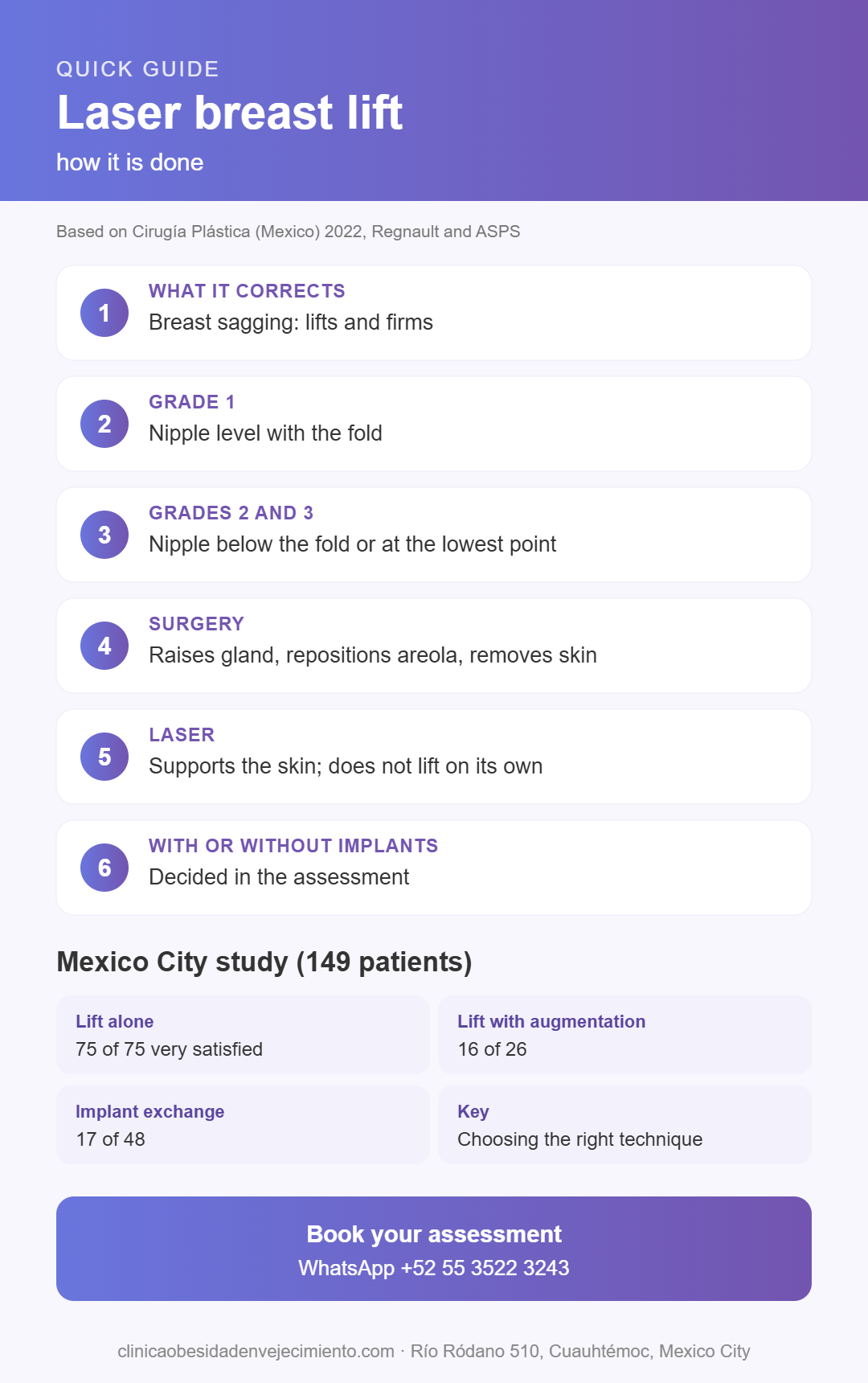
Sources
- Cirugía Plástica (Mexico). Mastopexy: satisfaction and complications by technique, 149 patients. Cir Plast. 2022;32(2):69-81. Medigraphic
- Regnault P. Breast ptosis. Definition and treatment. Clin Plast Surg. 1976;3(2):193-203. PubMed
- American Society of Plastic Surgeons. Breast lift (mastopexy). ASPS
- The Endo-lift laser (intralesional 1470 nm diode laser) for dermatological aesthetic conditions: a systematic review. Aesthetic Plast Surg. 2024. PubMed
- COFEPRIS. Statement 96/2023: recommendations on cosmetic procedures. gob.mx