
Reviewed by clinicaobesidadenvejecimiento.com · Last review:
Sagging buttocks are mainly caused by weight gain, age and weight loss. A classic study classifies sagging as pseudoptosis, preptosis and true ptosis. Exercise improves the muscle, but when skin and fat have already descended, the medical option is to reposition or add volume, for example with a buttock lift.
- Weight
- Age
- Weight loss
- Assessment
Why do buttocks sag?
They sag due to a combination of weight, age and sharp weight changes, which stretch the skin and shift fat.
A study in Aesthetic Plastic Surgery (2006) found that weight, age and weight loss are related to the severity of sagging.
How is buttock sagging classified?
It is classified into three types, depending on where the fold is and how much tissue has descended.
| Type | What is seen |
|---|---|
| Pseudoptosis | Excess skin or fat below the fold, with the buttock in place |
| Preptosis | Early descent with a deeper fold |
| True ptosis | The buttock descends below the fold, in five grades of severity |
Source: Gonzalez 2006.
Can exercise lift the buttocks?
Exercise strengthens the muscle and improves posture, but it does not reposition skin or fat that has already descended.
That is why it helps in mild sagging and as a complement to any treatment.
What medical options exist?
Options depend on the degree of sagging and the fat available.
- Mild sagging: exercise and weight control.
- Lack of projection: grafting your own fat into the buttock.
- Sagging with volume loss: laser buttock lift, which combines liposuction and grafting.
What is not recommended?
Injections of modeling substances such as biopolymers or oils are not recommended.
COFEPRIS warns they are high risk to health; if already applied, the clinic offers laser biopolymer removal.
Myth and fact
Myth: “Squats alone fix any sagging.”
Fact: Exercise helps the muscle; it does not reposition skin or fat.
Myth: “Losing weight always lifts the buttocks.”
Fact: Weight loss can increase sagging (Gonzalez 2006).
Myth: ““Non-surgical” fillers are harmless.”
Fact: Modeling substances are high risk (COFEPRIS).
Have your buttocks lost their shape?
Book an assessment to learn your degree of sagging and the option that really suits you.
Book an assessmentFrequently asked questions
At what age do buttocks sag?
There is no fixed age; weight, genetics and weight changes all play a role.
Does weight loss make sagging worse?
It can, because the skin is left with less support (Gonzalez 2006).
Are there non-surgical treatments?
They help skin firmness but do not reposition sagging tissue.
What if I have biopolymers?
They are assessed first; they may need removal before another procedure.
Keep reading
Downloadable quick guide. Causes, types of sagging and medical options in one image.
Download infographic (PNG)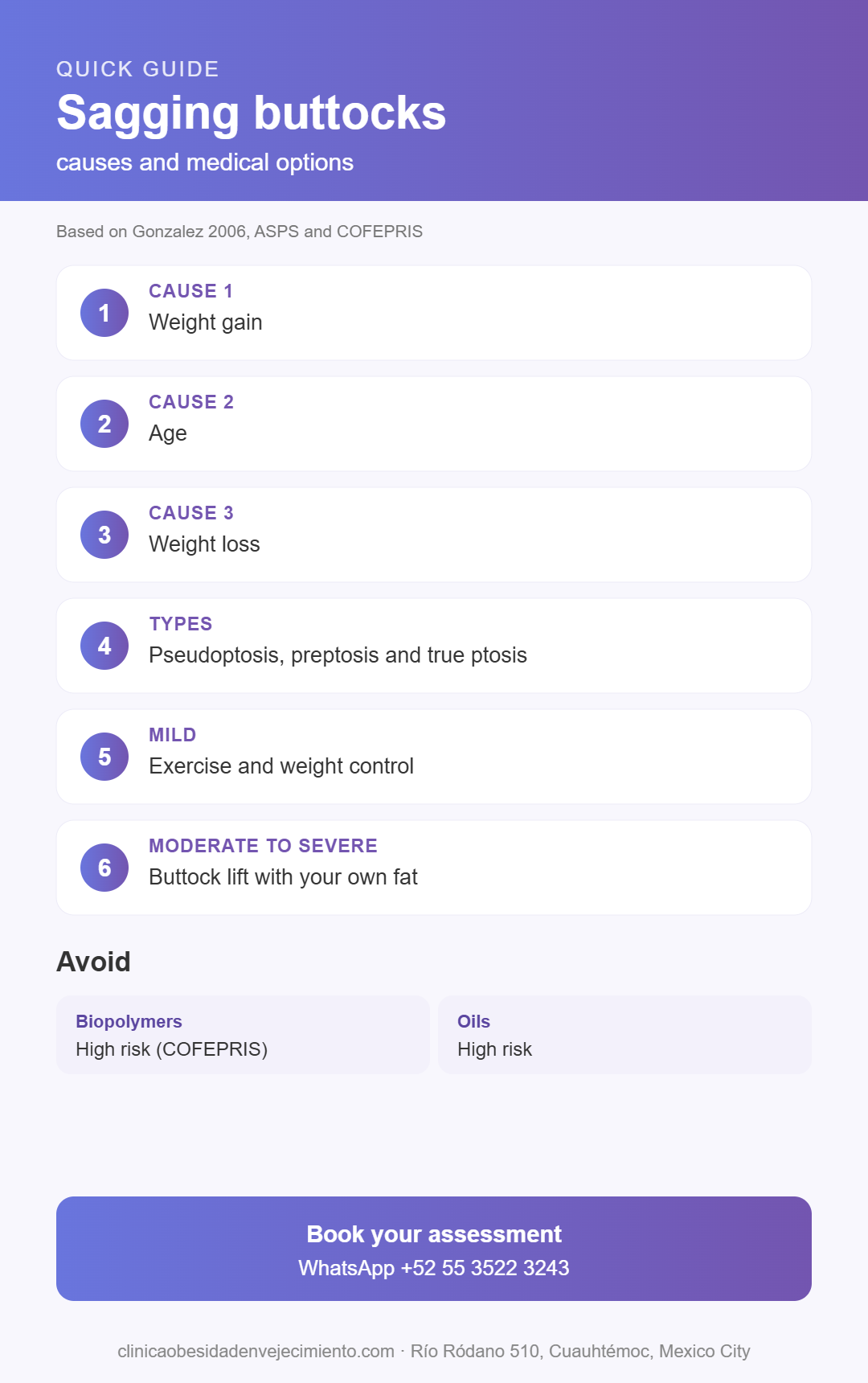
Sources
- Gonzalez R. Etiology, definition, and classification of gluteal ptosis. Aesthetic Plast Surg. 2006;30(3):320-326. PubMed
- American Society of Plastic Surgeons. Buttock augmentation. ASPS
- COFEPRIS. High-risk modeling substances. gob.mx
- Mofid MM, et al. Report on mortality from gluteal fat grafting. Aesthet Surg J. 2017;37(7):796-806. PubMed